Last July, Steven Russell was reading below grade level, couldn’t shoot a basketball anywhere near the hoop and was often frustrated and angry—especially when it came to schoolwork. So when the Cave Creek third-grader was flagged during a school vision screening, the reason for his symptoms came sharply into focus.
Steven’s parents scheduled a follow-up appointment with an optometrist, who gave their son a passing mark. But his mother, Patty, felt unsettled after hearing the results. “It just didn’t seem right,” she recalls. “When I sat to read with him I couldn’t see it but when I stood in front of him his eyes danced all over the place.” Months later, Patty’s hairdresser introduced her to a woman with a similar story, who suggested they visit another optometrist. That eye care professional referred them to Advanced Vision and Achievement Center in Scottsdale and vision therapist Tennille Murphy.
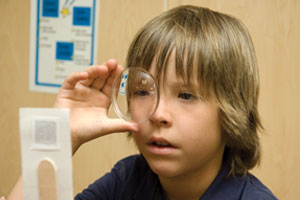
Murphy recommended specific exercises for Steven, who tracked moving targets and worked mazes using only his eyes. Murphy used different lenses, near and far charts and other tools to help Steven’s eyes work together and focus on individual words. In a matter of months, Steven went from picture books to chapter books, has earned straight As and is now on the honor roll.
If you have concerns about your child’s vision, finding the right professional can be challenging but it is critical to success. Almost 90 percent of learning is visual.
“The ability to see clearly is just one visual skill,” explains Scottsdale optometrist Stephen Cohen, O.D. “ The problem is that we rely on eye charts too much for vision. There are other skills that come into play. Maybe you can see the board clearly but you can’t make the transition from the board to the desk. That can slow down work that requires copying from the board. What happens when you have to read for an extended period of time? Are you able to keep images clear and single? Do you have headaches when reading? And how do eyes work together as team? It’s like a horse-drawn carriage. If one is stronger they are constantly trying to make adjustments to work together.”
It is important to find a vision specialist who can look at all of the functions of the visual system. So whom should you see? Asking family members or friends who have dealt with similar issues is a good way to find the right kind of professional. There are three basic types of eye care professionals, all of which can prescribe glasses for your child:
-
- An ophthalmologist is a medical doctor (M.D.) who specializes in all aspects of eye care including diagnosis, management and surgery of ocular diseases and disorders, according to the American Academy of Ophthalmology (AAO). Ophthalmologists specialize in finding and treating diseases of the eyes and surrounding areas. You can certainly see an ophthalmologist for routine eye exams, though, and many ophthalmologists recommend it.
- A doctor of optometry (O.D.) diagnoses and treats most vision problems and refers patients to specialists. Optometrists do at least four years of post-graduate, doctoral-level study concentrating for the structure, function and disorders of the eye, according to the website of the American Optometric Association (AOA). Ophthalmologists specialize in finding and treating diseases of the eyes and surrounding areas.
- Behavioral optometrists also have degrees in optometry but have taken additional training that emphasizes developmental and behavioral aspects of vision care. The College of Optometrists in Vision Development (COVD) certifies professional competency in vision therapy.
Here are some examples of exercises a vision therapist might use:
-
- For problems with tracking: Hang a Marsden Ball (a ball on a string) from the ceiling and have the patient either lay under it or sit or stand in front of it and follow the movement of the ball with their eyes. Murphy places a bean bag on a child’s head to build awareness of unintentional head movements that can interfere with the goal of making only the eyes do the work. “As we move the ball in various directions (up/down, side/side, diagonals, circles, etc.), we watch their eyes and give them feedback as to when/if their eyes move off of the ball (lose fixation), if their eyes stutter/have sticky movement, or move past the ball (overshoot). We can do several things with the ball, like have them tap it and read letters off of it. She says even Olympic athletes use this exercise in training.
- For problems with eye teaming (working together) or double vision: a Brock String—a string with beads placed at various points—is held out straight in front of the child’s nose. The child looks down the string, trying to single out a specific bead. “With this exercise we can help them learn when they are using one eye or both and where they are aiming their eyes,” Murphy says. “We can coach them to change how they are aiming their eyes. This is a popular one with baseball players: Do they see one ball or two? Are they aiming their eyes on the ball? If they a looking just in front of the ball, it can cause them to swing early. If they are aiming their eyes past the target they would swing late.”
- Different lenses, prisms, special glasses, patches, etc. can help the patient learn how to tighten/relax their eyes, how to aim their eyes in and out and more.
“It’s very rewarding to see kids make these great turnarounds,” says Murphy. “They come in really struggling in school and with low self-esteem and I get to see them develop and become more themselves.”
Signs of vision problems
If your child displays some of the following symptoms, it may be time to see a vision specialist:
- Complaining of double vision
- Nose right over the book or paper
- Goofing off or entertaining during study time
- Not making eye contact
- Coordination problems, especially with sports
- Bumps into things
- Homework takes an excessive amount of time
- Poor comprehension skills
- Trouble copying information
- In-class behavior problems such as a short attention span or fidgeting
- Avoids reading out loud—may move head instead of eyes while reading
- Headaches