The acronym STEM (Science, Technology, Engineering, Mathematics) gets used a lot in education. I visit schools to see STEM activities and sometimes they are mostly S with some T, or plenty of E but little S. A true STEM curriculum integrates science, technology, engineering and mathematics to solve problems and enhance the discussion of issues like climate change or alternative energy.
In 2012, the APS Foundation launched an initiative to promote STEM education. The company awarded a grant to the Center for Science, Teaching and Learning (CSTL) at NAU for the STEM-Focused Schools for the Future project as part of this initiative. The goal of the program is to create 12 STEM-focused schools across Arizona. The CSTL trains teachers to become leaders at their schools and then in turn to teach their colleagues how to improve STEM teaching and learning.
One of the 12 schools is Copper Ridge School in Scottsdale. This week some fifth-grade students in Nanette Hubbell’s class did a STEM lesson in hydroponic gardening. Hubbell isn’t new to integrating content areas into a curriculum. She started teaching fifth- and sixth-graders at Aztec Elementary in Scottsdale in 1993, and she’s been integrating the curriculum for much of her 30 years in education. (Note: I started my teaching career at Aztec in 1993 and know Nanette from my years there.)
Aztec Elementary used the Integrated Thematic Instruction (ITI) model designed by Susan Kovalik to integrate the content areas around a year-long theme. Hubbell says the biggest difference between STEM and ITI is that STEM focuses on science, math and technology.
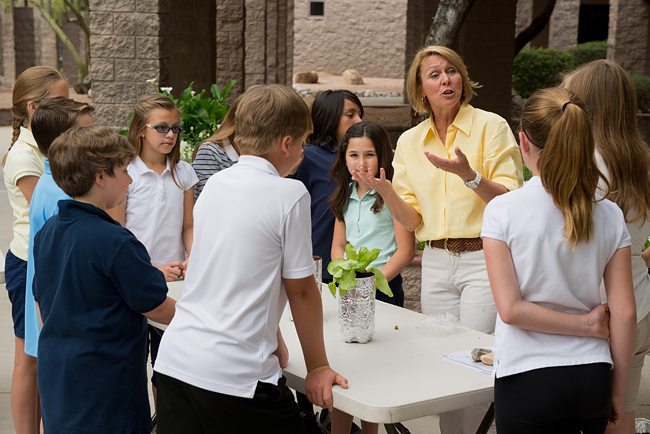
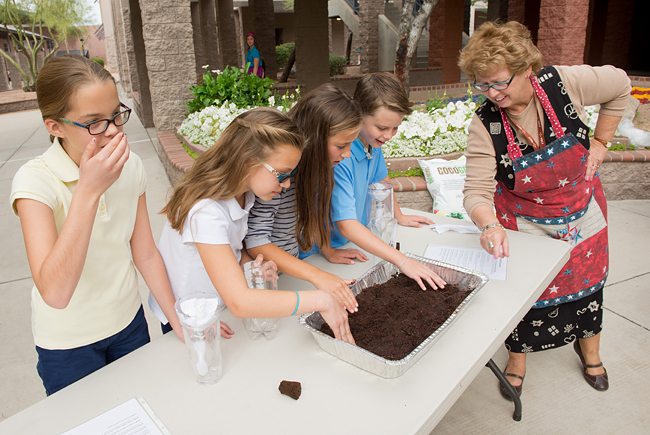
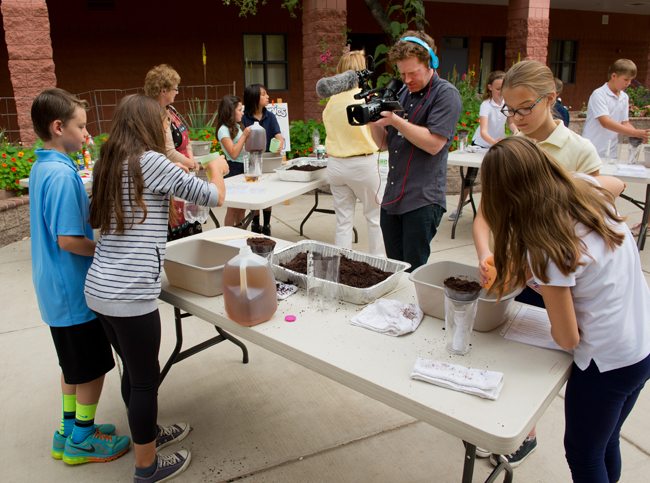
Karen Klein, the master gardener at Copper Ridge, was in charge of the lesson. The flower beds were brimming with colorful flowers, strawberries and chard, which made a perfect setting for the videographer that members of CSTL brought along from Flagstaff to record the lesson as an example of what a STEM lesson can look like. Jane Kirkley and Joelle Clark, professional development coordinators at CST, were there to observe the activity and talk to students.
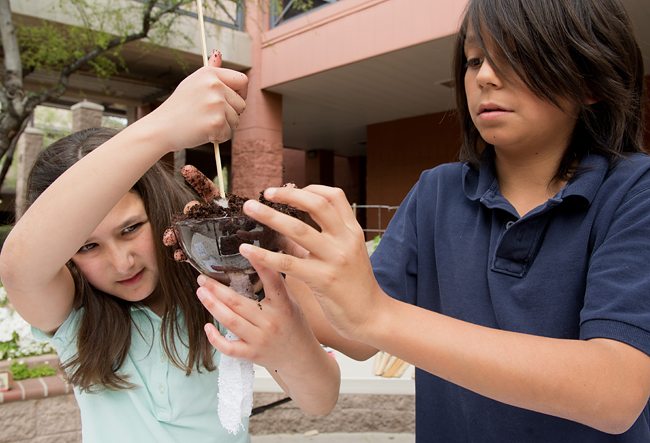
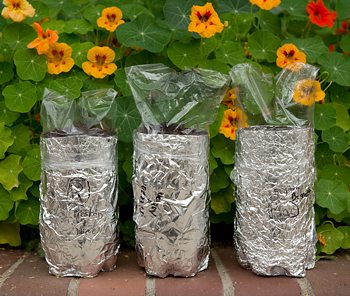
The students made a hydroponic planter from an empty plastic soda bottle, a dishtowel, fiber wick, coconut coir made from coconut husks, plugs made from composted tree bark to help the plant take root and liquid plant nutrients.
The scientific issue at hand was how to grow food without knocking down a forest or turning natural habitats into farmland. Klein asked the students if they could grow food without dirt. Klein had a finished planter with lettuce growing as proof of the concept, but the students built their own to see the lettuce seeds sprout after all the materials went together.
Jane Kirkley explained that with STEM, integrating the E—engineering—into a lesson is the most difficult part. Engineering is trial and error that may not follow a predetermined path, with some luck thrown in. Traditionally, schools teach discrete subjects which make for easily testable concepts measured on high-stakes tests. Kirkley says the idea is to make the connection between scientific concepts and the world as well as to break down barriers between traditional subject areas.
Kirkley adds that STEM helps students “See the big picture on how the world works and what scientists do. Science is a body of knowledge and a way to build that body of knowledge. Bring in engineers to see how it all fits together and maybe it will all make sense.” She says CSTL is trying to get teachers “away from the myth of the scientific method.”
The traditional combination of observation, hypothesis, prediction and test doesn’t work when trying to engineer solutions, says Kirkley. It’s too messy. It isn’t supposed to be like a recipe.
Kirkley says CSTL trains teachers to think of how to create a STEM school. The 12 schools have varying levels of resources, so simply assembling science materials may be the first step for some schools with smaller budgets. A teacher and principal come to CSTL to learn the content material for STEM along with the teaching methods to make their school a STEM school. Then they teach colleagues.
At the end of the activity, the students’ hydroponic gardens were lined up along benches around the garden. In the coming weeks students will measure plant growth. Though they didn’t do the engineering to invent the hydroponic planters, they saw how it is possible to re-purpose an empty soda bottle for food production and whether it is sustainable and efficient. Hubbell says in her classroom she “grows thinkers,” not just students who can recite and remember facts.