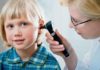
Several states require eye exams prior to school enrollment, but Arizona is not among them, according to Jane Lynch, executive director of the American Optometric Association (AOA). Still, she says, comprehensive vision exams are important for young children.
“Vision is the predominant sense of learning,” observes Scottsdale optometrist Stephen Cohen, D.O. “Eighty percent of what we learn is through the visual system.” For Cohen, thorough vision exams are right up there with routine dental exams and immunizations. He’s amazed some parents spend more time finding the perfect back-to-school backpack or pencil box than assessing their child’s vision readiness for school.
Don’t assume that exams performed by your child’s pediatrician or school nurse will catch all vision problems. Cohen says studies show these quick exams miss nearly a quarter of all problems. In one recent study, preschoolers recieved both typical school screening exams and comprehensive eye exams administered by eye health professionals. In nearly 40 percent of the cases, school screening techniques failed to identify preschoolers later found to have amblyopia, astigmatism, refractive error (nearsightedness/farsightedness) or unexplained reduced vision.
“School screenings are valuable tools, but they can give parents a false sense of security,” Cohen says.
The ability to see clearly — what we consider 20/20 vision — is only one aspect of good vision. There are several “basic vision skills” needed for school, according to AOA experts. These include near vision, distance vision, binocular coordinations (how well the eyes work together), focusing skills, peripheral awareness and eye/hand coordination.
Cohen says a comprehensive eye exam addresses:
• Your child’s overall eye health.
• How well your child’s eyes track objects (such as letters in a sentence).
• How well your child shifts focus from close-up to far-away objects (such as desktop to blackboard).
• Eye coordination (how well the eyes work together as a team).
There is “a strong familial component” to vision, says Cohen. Parents who are near- or farsighted, or have astigmatism (asymmetrically curved corneas that interfere with focusing), should be especially vigilant about their children’s early eye health.
Risk factors that may affect vision include premature birth, developmental delay, previous serious eye injury, taking certain medications and African-American heritage (which increases the risk for glaucoma), according to the American Acadmemy of Opthamology.
Early intervention can improve the outcome for many vision-related problems, according to Manisha Geier, O.D., an optometrist with Nationwide Vision and Laser Eye Center in Scottsdale. Geiger recomments that all children have “a full eye exam” before age 3. Some experts recommend an eye exam by age 1, and pediatricians begin checking for eye problems even before that first birthday.
Vision problems can interfere with reading, copying information from the blackboard and other essential school skills, so it’s important to identify vision problems that affect learning “before a child gets held back in school or labeled a behavior problem,” says Geiger.
Watch for “red flags” that may signal vision problems, urges Cohen. These include:
• Headaches. Vision-related headaches often occur in the temples at the side or the forehead or in the frontal/forehead area. They’re more common on school days and tend to occur in the late afternoon. Such headaches often signal eye strain.
• Excessive tearing or redness of the eye.
• Fluctuations in vision. Take note if your child complains of fuzzy vision, even if it occurs only part of the time rather than consistently throughout the day.
• Fatigue. Eye problems may make your child fall asleep while reading. Don’t assume nighttime sleepiness or boring reading materials could be the only possible explanations.
Other symptoms noted by AOA professionals include avoiding close work, rubbing the eyes more than usual and the following reading difficulties: losing one’s place while reading, holding reading materials closer than normal, using a finger to follow along while reading, turning or tilting the head while reading, omitting or confusing small words when reading or making frequent reversals while reading or writing.
Both opthalmologists and optometrists perform eye exams and vision screenings. Pediatric opthamologists are medical doctors (M.D.s) who specialize in eye health and receive additional training in working with children and teens. Optometrists complete four years of education at a college of optometry, leading to the doctor of optometry (D.O.) degree.