
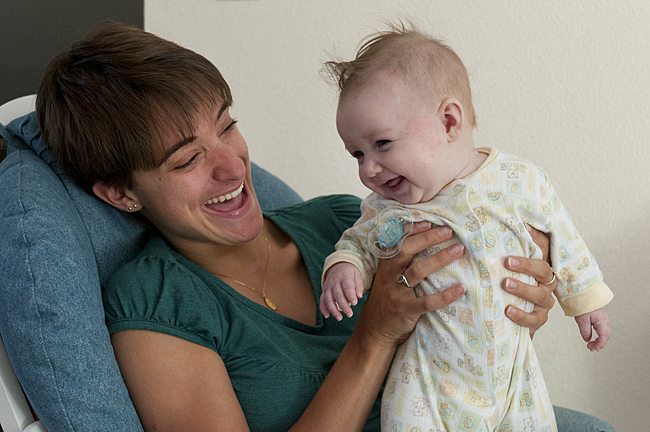
Kelli was just 18 when she got pregnant. She knew her boyfriend wasn’t going to be any help and she couldn’t go home because she and her mom were estranged after years of painful misunderstandings and resentment. She was alone—and scared.
One day, she met a friend for coffee. “I’m pregnant,” she said. “I don’t know what to do.”
A coffee shop patron stepped near and said, “Please excuse me. I don’t mean to eavesdrop, but I’ve heard of a place that could help.” Kelli learned about Maggie’s Place, a local nonprofit that welcomes women who are pregnant and alone or homeless and in need of support. At Maggie’s Place, these women are allowed to live in respectful, nurturing communities where they can work to achieve their goals while awaiting the arrival of their babies and adjusting to the demands of new motherhood.
Kelli immediately went online to find a phone number. She called Maggie’s Place but learned there were no openings. She was told to call back the next Tuesday to schedule an interview, but she didn’t do it. “I was still in total denial,” Kelli says. Four weeks later, she finally called.
“I arrived just in time for dinner,” she says. “I cried, thinking I was going to a cold, lonely shelter. Instead I found a home. Even better—a family of friends.”
Kelli spent five months at Elizabeth House, one of several Maggie’s Place communities. Three years later, she has an even greater appreciation for it. “I learned so much about myself while I was here,” she says, sitting at the kitchen table at the Tempe shelter. “All the bad stuff that had happened to me was a true blessing because I found Maggie’s Place.”
Who started Maggie’s Place?
In early 1999, a group of young women came together with an idea. “We were recent college graduates who shared a passion for social justice,” recalls Mary Peterson, co-founder and executive director of Phoenix-based Maggie’s Place. “We knew each loosely through friendships and work relationships.”
As an expression of their faith, the five co-founders wanted to open a “house of hospitality” in the Catholic Worker tradition of journalists/advocates Dorothy Day and Peter Maurin. So great was their commitment that they initially placed their own career plans and romantic relationships on hold as they worked to open a house that would welcome pregnant women who are on the streets or alone.
As word spread, many individuals stepped forward to help. During an Easter potluck, the women met an advocate for affordable housing who provided a 1926 bungalow in central Phoenix. The house had been sitting vacant for years; it took a volunteer crew nine months to gut and rebuild the structure.
On Mother’s Day 2000, The Magdalene House opened its doors. Since then, Maggie’s Place has expanded to include The Elizabeth House (opened in Tempe in January 2005) and The Michael House (opened in Glendale in March 2007). An administrative building called The Fiat House, which also serves as a place to conduct outreach to alumnae moms, was acquired in April 2006. In October 2008, The Mary House opened in Coeur d’Alene, Idaho. The Zechariah House opened near Cleveland, Ohio last summer and more Maggie’s House communities are planned. Since its inception, Maggie’s Place has provided homes to more than 300 expectant mothers.
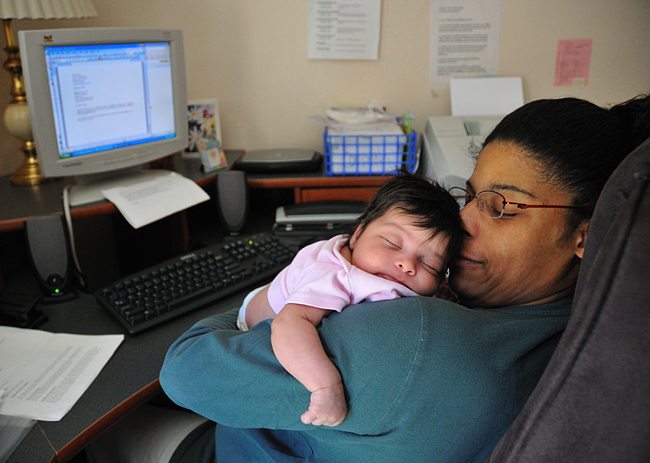
Building a community
Maggie’s Place communities welcome women who intend to keep and parent their children and those who decide to place their babies with adoptive families. The women must be 18 years of age or older and pregnant, with no other children in custody. They may stay until their babies are six months old. Though they typically have roots in complicated, unstable situations, they must be free from recent drug or alcohol use and not fleeing domestic abuse.
Guests must be committed to self-improvement and willing to live in accordance with “House Rules.” Maggie’s Place enforces a zero-tolerance policy for drugs, alcohol, weapons or violence. If a violation occurs, the violator must leave. The staff conducts random drug testing.
Once accepted, a mother-to-be’s immediate physical and emotional needs— including shelter, food, clothing and a supportive community—are the first priorities. Secondly, Maggie’s Place connects women to appropriate agencies and resources that can provide counseling, prenatal care, health insurance, low-cost housing and education programs.
Residents are encouraged to work continuously toward the goal of independent living. They participate in weekly community nights, when speakers educate the women and help prepare them for the actual moving out day or teach them about interview skills, nutrition, parenting, smoking cessation, anger management, exercise during pregnancy and more. Twice-monthly group counseling sessions offer a chance for them to learn about communication skills and conflict resolution.
Expectant women and recent moms, live-in staff members and lots of volunteers and visitors share in running the homes.
“One of our core beliefs is that pregnancy is meant to be experienced in the context of family,” says Peterson. Loving acts of selflessness on behalf of others are common; during one of my visits, a staff member temporarily gave up her bedroom so that a newly delivered mother could have a private room.
Pregnant women are expected to complete 40 hours of “productivity”—which can encompass outpatient counseling, employment, education, chores, cooking meals and many other acceptable options. For the first three weeks after giving birth, the requirement is reduced to 20 hours a week.
Answering a call to serve
Staff members who come to live at Maggie’s Place must commit to at least one year. Most are recent college graduates. They share administrative tasks, coordinate volunteer help, manage donations and often accompany the moms to delivery rooms. Staff members are provided with room and board, medical insurance and a small monthly stipend.
“One of the things that attracted me to Maggie’s Place is that this is a grassroots centered, non-profit organization,” says Dayna Pizzigoni, who was director of volunteers at The Elizabeth House at the time of our interview. (She is now in graduate school.) “Our executive director sleeps in a bunk bed. That kind of integrity and commitment to the mission impressed me.”
Five years ago, Becky Fair left her boyfriend, Jim, and her home in Pennsylvania to join the staff at Maggie’s Place. After they married in June 2006, they both joined the staff for the first two years of their marriage. “Male staffers typically help with house and vehicle maintenance and duty shifts,” says Fair. “They can also serve as important role models and make a big impact.” After one male staffer left, she recalls, “the moms said, ‘He restored my faith in men.’”
When Fair welcomed a daughter a little over a year ago, she gained a deeper appreciation of the challenges of motherhood. “I have a loving, supportive husband [but] I’m still overwhelmed,” she says. “Our moms are amazing.”
As single moms, Maggie’s House residents face the challenges and emotions all new mothers experience—and then some. “Most of our moms attempt breastfeeding, but they have many obstacles,” says Fair. “They usually go back to work or school pretty quickly. Nursing can take a while to learn—something I didn’t know until I experienced it. I was fortunate to rent a hospital-grade breast pump my first two months. Our moms can’t [afford to] do that.”
When Kristin Tegethoff joined the staff at Maggie’s Place in 2007, she was admittedly idealistic. “I thought I’d transfer the wisdom I had about happy/healthy families,” says Tegethoff, director of staff. “What I’ve found was I had much more to learn and receive than I had to give.”
Pizzigoni also arrived with preconceptions. “I thought, ‘I can hold their babies anytime and cook dinner. I can serve in all these extra ways aside from my official staff role to show my love.’ I quickly realized that there is a huge difference between enabling these moms and empowering them. Doing anything they can do for themselves is enabling, not empowering. Maggie’s Place is about their growth, not what we can do for them.”
A typical day
The hustle and bustle of a busy home life is evident at the Elizabeth House. Donations of food, baby items and laundry soap by a mom in minivan are delivered; a doctor’s appointment is noted on a large house calendar; the aroma of a freshly baked breakfast casserole wafts through the house.
A tour group is taken past the Tree of Life (a stunning display of metallic “leaf” baby announcements) located in the entryway; a pregnant mom requests her medications; sunlight gleams through the tiny chapel’s stained glass window; a sleep-deprived new mom munches on a bowl of cereal while her baby coos in a swing next to her. Outside, a staff member tends to the organic garden.
“Have you seen the keys to the Intrepid?” asks Pizzigoni.
“No, sorry,” Tegethoff responds.
“Have you seen the Intrepid?” Pizzigoni asks.
“Oh, that’s right…it’s in the shop for repairs,” Tegethoff responds.
The women, preoccupied by greater matters, share a laugh about their mutual memory lapse.
Each Maggie’s Place house has its own unique aspects but shares common attributes with the others. The Elizabeth House is home to four staff and can accommodate up to six moms/babies. The house has three bathrooms, a living room, a kitchen, a large laundry/storage area and an ample backyard with patio tables, chairs and lounges, citrus trees, a large garden, a small grotto, a hammock, a barbeque and a receiving area for donations. The house also has an office and an area for resident staff.
Every Maggie’s Place house has a chapel, and the staff breaks briefly for prayer three times a day. But guests and staff come from a wide variety of religious backgrounds and those differences are respected. “Participation in spiritual opportunities by our community is optional,” says Peterson. “It is by invitation, not expectation. We want everyone to feel welcome here.”
It takes a village
The success of Maggie’s Place depends on the commitment of a wide community of volunteers and donors.
Bob Hubbard, owner of the Hubbard Family Swim School, has been a board member since June 2003. He connected with Maggie’s Place after seeing an article about it in the Arizona Republic. “We started sending lost-and-found clothes from our swim school,” he says.
“We learn much from the dedication of the staff and the courage of the moms at Maggie’s Place,” says Hubbard. “We talk about the need to support moms who have elected to give birth despite difficult circumstances. Maggie’s Place provides a tangible alternative. Additionally, it gives the moms new skills to help them in their child-rearing and in life.”
Pizzigoni is constantly surprised by the generosity of an army of volunteers and donors—individuals, families, ministry groups, high school clubs and organizations like the National Charity League and Junior League. “Baby bottle drives are held,” she says. “Volunteers compete to collect loose change or share their allowances to fill up baby bottles.”
Maggie’s Place holds “Work Saturdays,” inviting groups to help clean the houses, wash cars, do yard work, organize, sort donations and more. “We’ve had people volunteer to cut hair, make meals…plumbers have volunteered their time, massage therapists have served our moms for free, newborn care specialists speak, lactation consultants assist the moms, restaurant owners have opened their doors to us…moms groups throw baby showers or special events, people drop off fresh fruits and vegetables…it’s wonderful,” says Pizzigoni.
One donor sends a dozen roses to each mom who gives birth. “We place the flowers on their bedside table for the homecoming,” says Tegethoff.
Moving on
When it’s time for a member of the community to move on, a “Candlelight Ceremony” is held. A candle is lit and all moms, staff, babies and invited guests gather in the living area. After everyone is welcomed and a Bible verse is read, the candle is passed around and each person shares a thought, well wishes, a funny story, a small gift or card to honor the departing mother or staff member. Finally, the person who is leaving voices her thoughts and thanks. There are many hugs, tears and moments of laughter.
“We strongly encourage our moms to keep in touch with the staff and each other,” says Fair. “Moms are always welcome to visit or join us for a meal. We have computers available for their use at The Fiat House. After they move out, the women can volunteer for Maggie’s Place in exchange for donations (baby items, clothes, household items, etc.).”
Kelli, who is now working as a flight attendant, was grateful for an easy delivery she credits to a doula’s gracious offer of free service. She hopes to become a childbirth educator and, ultimately, a midwife. Sage, now almost 3, is a happy, healthy toddler. Kelli has reunited with her high school sweetheart, now fiancée, who intends to adopt Sage. She and her mother have reconciled and they now enjoy a strong, supportive and loving relationship.
“I had to relearn what strength is,” she says of her experience with Maggie’s Place. “[It’s] not suffering through pain but leaving it behind never to return. I am strong without pain or heartache. A victim or martyr is no longer my idea of strength—my idea of strength is a woman unscathed.”
Learn more
Maggie’s Place is a 501(c)(3) non-profit organization that depends on private individuals, families and organizations for financial assistance and does not receive government funds. maggiesplace.org.