Answers are attributed to Russell Horton, DO, FAAP, Division Medical Director of Primary Care for Banner Medical Group.
 Signs of overheating that parents should monitor include sweating, flushed skin, or the infant’s chest feeling hot to the touch. The baby may also seem to be fussier or eat less, but these are less specific symptoms.
Sleep Clothing and Sleep Sacks in Hot Weather
Generaly infants should wear one more layer than the adults in the home at whatever preferred temperature the home is. Excessive clothing or blankets are associated with increased SIDS risk. In hot weather, this may mean a lightweight sleep sack or even just a onesie..
Fans and Air Conditioning Overnight
There is no hard and fast rule, but fans can be used to help cool but should not be blowing directly on the baby. Air conditioning (if available) can be helpful when kept at a comfortable temperature.
Preventing Overheating When Baby-Wearing
Dress the infant appropriately for the environment with no more than one layer more than an adult would wear. If you are using an infant sling and/or cloth carriers, ensure the infant’s head is upright and above the fabric, the face is visible, and the nose and mouth are clear of obstructions. In hot weather, remember that the carrier itself adds a layer, and body-to-body contact generates additional heat.
Detecting Overheating While Baby-Wearing
Check for sweating, flushed skin, or if the infant’s chest feels hot to the touch. Parents should periodically check the baby’s temperature by feeling the back of the neck or chest (not hands or feet, which are often cooler). Additional warning signs could include excessive fussiness, lethargy, or decreased responsiveness.
Hydration for Infants Who Cannot Have Water
Exclusively breastfed infants do not need supplemental water to maintain hydration, even in hot weather. For formula-fed infants, continue regular formula feeding. Breastfed infants should continue nursing throughout periods of heat exposure.
Feeding Frequency in Hot Weather
Feeding frequency may need to increase during hot weather. Parents should offer feeds more often and watch for signs of adequate hydration (like normal amounts of wet diapers).
Sunscreen Safety and Recommendations
Sunscreen is safe to use starting at 6 months of age. The AAP and CDC recommend physical (mineral) sunscreens containing titanium dioxide or zinc oxide for children over 6 months, as these are less irritating to sensitive skin than chemical sunscreens.
For babies under 6 months, sunscreen should be avoided as the primary protection method. However, a small amount of sunscreen can be applied to small, exposed areas including the infant’s face and hands when other protection is insufficient. Severe sunburn in young infants is a medical emergency.
Use broad-spectrum sunscreen with SPF 30 or higher, apply 15 minutes before sun exposure (for chemical sunscreens; physical sunscreens don’t require this delay), and reapply every 1-2 hours.
Physical Sun Protection Strategies
For infants under 6 months:
– Keep in the shade as the primary protection
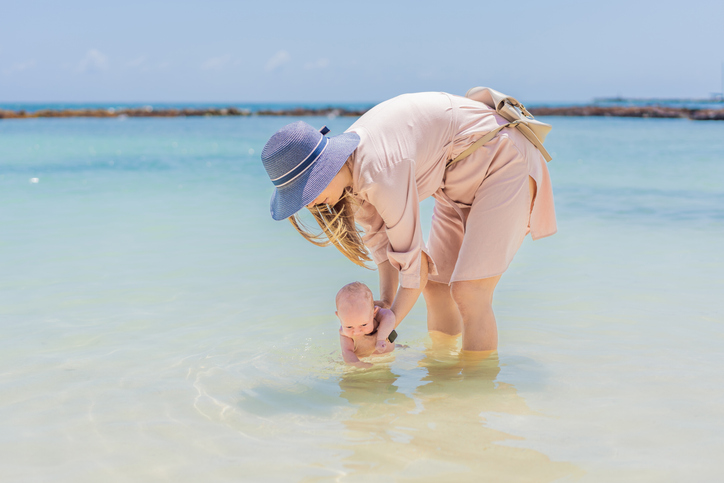
– Dress in lightweight, long-sleeved shirts, long pants, and wide-brimmed hats
– Use covered strollers, umbrellas, or portable shade shelters
– Limit direct sunlight exposure, especially at midday
For all infants:
– Sun-protective clothing (UPF-rated swim shirts) is highly effective
– Wide-brimmed hats and sunglasses reduce skin and eye injury
– Seek shade, especially between 10 AM and 4 PM when there is the most UV exposure.
Car Seat Cooling Pads and Inserts
Infants should be removed from car seats as soon as they arrive at their destination and should not be left to sleep in car seats outside of the vehicle. Car seats can become extremely hot in vehicles, so checking the seat temperature before placing the infant and using window shades are safer approaches than adding products. It is important to remember that anything added to a car seat is outside of its design and safety testing and could affect the proper functioning of the car seat.
Products to Avoid
Avoid inclined sleepers and any sleep surface that is not firm, flat, and noninclined. While not specifically about cooling, the AAP warns against commercial devices inconsistent with safe sleep recommendations. Be cautious of any cooling products that:
– Add soft materials to the sleep surface
– Could cover the infant’s face
– Create gaps or entrapment hazards
– Have not been safety tested
Safely Cooling an Overheated Baby
To cool a mildly overheated infant:
– Move to a cool environment immediately
– Remove excess clothing
– Offer fluids (breast milk or formula)
– Use room temperature water sponging (not cold or ice water for mild overheating)
– Use fans to promote air circulation
For signs of heat exhaustion or heat stroke (altered mental status, core temperature >104°F/40°C, seizures):
– Call 911 immediately
– Move to cool environment
– Remove clothing
Heat stroke in infants is a medical emergency requiring immediate professional care.