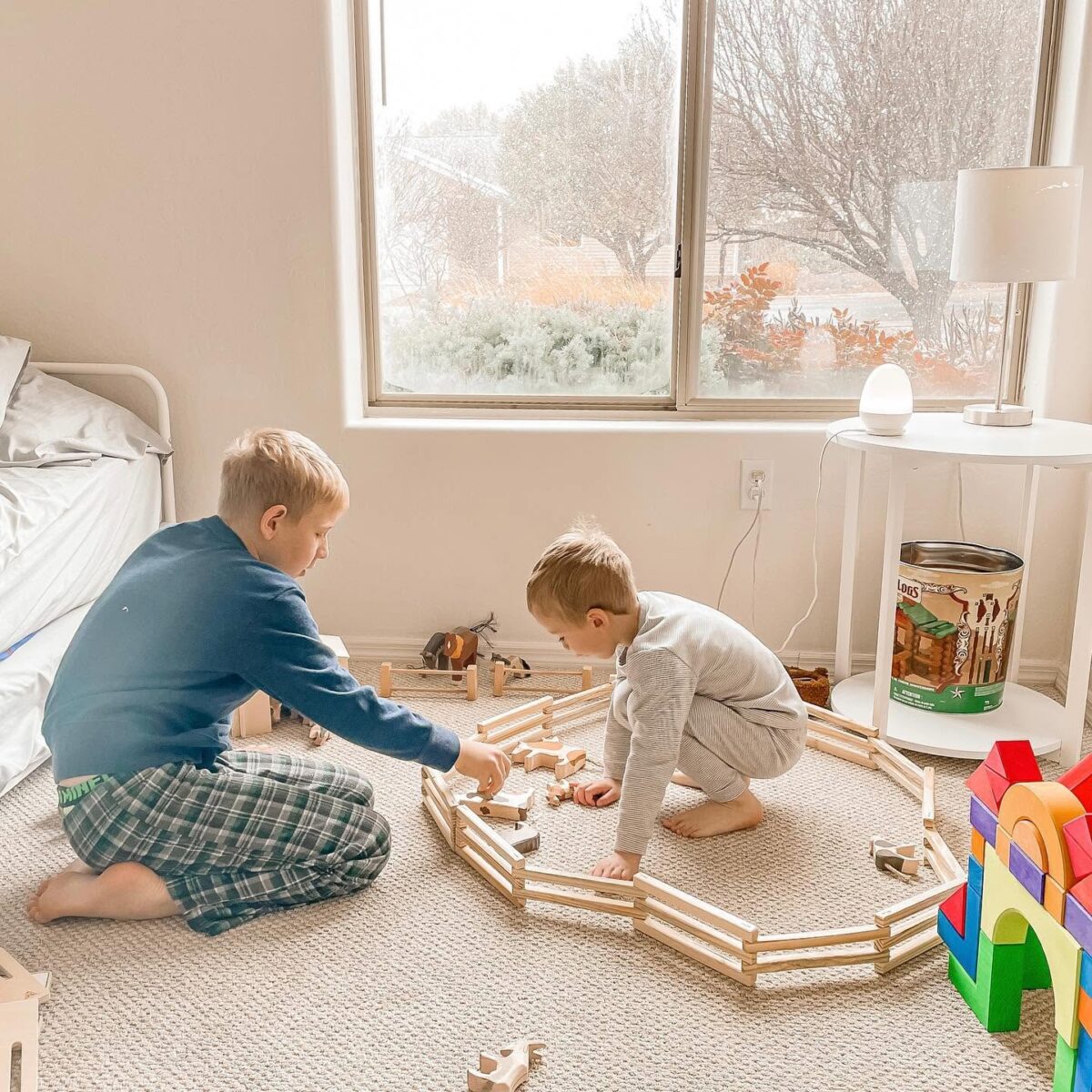
 From wooden blocks and play kitchens to climbing domes, LEGO, art supplies and 3D printers, these Christmas gift ideas encourage creativity, problem-solving and imagination.
Every Christmas, parents and grandparents face the same question: What should we get the kids?
There are plenty of toys that catch a child’s attention in the store, but how many will they still be playing with a few months later?
As a mom of five, with another on the way, I’ve learned that some of the best toys aren’t necessarily the newest or most expensive. They’re the ones that can be used in a dozen different ways, grow with children as their interests change and encourage them to use their imaginations.
And don’t get me wrong, my kids love their Hot Wheels loop tracks, Little People toys and plenty of other toys that light up, make noise or require batteries. We have lots of those in our house, too!
But I also work from home, and with five kids (soon to be six!), I’ve developed a special appreciation for toys that don’t sing, beep or make noise every time someone touches them. The quieter, the better!
That’s part of why I love open-ended toys. They’re often simple, but they give kids so many different ways to play. And some of the toys we’ve gotten the most use out of over the years have been the ones that don’t do much of anything on their own. The kids do all the work—and that’s exactly what makes them so great.
Many of these toys are Montessori-inspired or encourage the same kind of independent, hands-on learning. Others are simply classic toys that have been entertaining children for generations.
This Christmas, instead of focusing only on what’s trending, consider gifts that encourage kids to move, create, imagine, experiment and explore.
Jump to Gift Ideas
Active Play: Gifts That Get Kids Moving
Kids need opportunities to climb, jump, balance, swing and explore what their bodies can do. And while playgrounds are wonderful, there are plenty of ways to encourage active play right at home, indoors and out.
Outdoor Play Ideas:
- Backyard climbing domes
- Wooden playsets and climbing structures
- Tree swings and saucer swings
- Backyard ziplines
- Balance beams and stepping stones
- Obstacle course equipment
- Scooters, bikes and ride-on toys
- Slacklines and outdoor climbing equipment
Indoor Play Ideas:
- Pikler triangles and wooden climbing arches
- Indoor climbing domes
- Climbing ramps and indoor slides
- Foam climbing blocks
- Wooden balance boards and wobble boards
- Curved wooden rockers and rocking boards
- Sensory spinning chairs and sit-and-spin toys
- Balance beams and stepping stones
- Modular climbing gyms
- Soft obstacle course equipment
- Crash Pad (this was a favorite with our boys)
Balance Boards, Rockers and Spinning Chairs
These are great options for kids who love movement but can’t always get outside. Curved wooden balance boards can be used for balancing, rocking or even as bridges and tunnels during pretend play. Spinning chairs and sit-and-spin toys give children opportunities to explore movement while staying close to the ground.
Brands worth exploring include Kinderfeets for wooden balance toys and Gonge for active play equipment.
Play Couches
These deserve a special mention! Modular foam couches can become forts, tunnels, slides, obstacle courses, reading nooks or whatever else kids dream up. And when playtime is over, they can be put back together as furniture.
Popular options include Nugget and Yourigami.
Money-saving tip: Check your local Sam’s Club and Costco too! Both are worth checking for play couches and modular foam furniture, sometimes at lower prices than specialty brands. Selection and availability vary by location and season.
Why This Play Matters: Climbing, balancing and other physical activities help children develop coordination, strength, body awareness and confidence. Rocking, spinning and balancing also engage the vestibular system, which helps children develop their sense of balance and movement.
Choose age-appropriate equipment, follow manufacturer safety instructions and supervise climbing and spinning activities. Outdoor equipment needs proper installation and suitable fall protection.
Building and Construction: Gifts for Little Problem-Solvers
Some toys come with instructions. Others let kids decide what to build, how to build it and what to do when it doesn’t work the first time.
Building toys encourage children to experiment, solve problems and try new ideas. And many of these toys can grow with kids, becoming more complex as their skills develop.
Gift Ideas:
- Wooden building blocks
- MAGNA-TILES and other magnetic building tiles
- LEGO Classic bricks and LEGO DUPLO
- Wooden stacking rainbows and nesting arches
- Wooden building planks
- Marble runs
- Gears and mechanical building sets
- Wooden train tracks
- Large foam building blocks
- Interlocking wooden city-building sets
- Pattern blocks and tangrams
- Wooden peg dolls and loose parts
- Building planks and construction boards
Wooden Blocks, Rainbows and Building Planks
Traditional wooden blocks are hard to beat. Kids can stack them, knock them down, build towers, make roads or create homes for their favorite animals and figures.
Wooden stacking rainbows and nesting arches are another fun option. The curved pieces can become bridges, tunnels, fences or parts of a larger creation.
Brands like GRIMM’S and Green Elephant Home and Toys offer wooden toys and open-ended play materials. But there are also shops on Etsy as well.
For kids who enjoy more elaborate construction, KAPLA makes identical wooden planks that can be stacked into towers, bridges, buildings and other structures without connectors or glue.
And don’t forget Lincoln Logs! These classic wooden building sets let kids construct log cabins, forts, barns and entire little villages. Add toy animals, cars or miniature figures, and they become part of imaginative play, too. They’re another great example of a toy that encourages kids to build, take apart and start all over again.
LEGO: More Than Just Following Instructions
LEGO sets are always popular gifts, but don’t overlook the simple boxes of assorted bricks!
While themed sets are fun to build, LEGO Classic encourages kids to come up with their own creations.
They can build houses, vehicles, animals, cities, spaceships or whatever else they imagine. Add wheels, windows, doors and baseplates for even more possibilities.
And if they’re looking for inspiration, give them a challenge: build a bridge that can hold a toy car, create a maze, design a dream house or invent a new animal.
For younger builders, LEGO DUPLO offers larger bricks that are easier for little hands to manage.
Toy Roads: Build an Entire City
For kids who love cars and trucks, toy roads are a fun way to take their play beyond traditional racetracks.
Waytoplay makes flexible rubber road pieces that can be connected and rearranged into different layouts. Add wooden blocks for buildings, peg dolls for people and a few favorite vehicles, and kids can create their own little neighborhoods.
Another option is PlayTape, removable road tape that can be applied to suitable surfaces to create streets, intersections and racetracks. It’s especially fun for kids who already have a collection of Hot Wheels or Matchbox cars.
Interlocking Wooden Cities and Buildings
The Freckled Frog’s Happy Architect building sets have been favorites in our house for years. The flat wooden pieces slot together to create all kinds of buildings and scenes, and they’re easy for kids to take apart and rebuild.
We have several different sets, including ones with hospitals, police stations, schools and fire stations, plus a prehistoric-themed set with volcanoes and lava that’s perfect for dinosaur lovers.
What I love is how easily they work with other toys. Add peg dolls, wooden vehicles, toy roads, dinosaurs or even monster trucks, and suddenly the kids have an entire world they’ve built themselves.
You can explore the different sets from The Freckled Frog.
Wooden Train Sets
Wooden train sets are another gift that can grow over time. Start with a simple track and a few trains, then add bridges, tunnels, stations and other accessories for birthdays and holidays. Years ago we had a really fun train table that I found second hand but we don’t have room for it anymore so our kids just build sets on the ground, dining table, or coffee table!
Brands like BRIO and IKEA offer wooden train systems.
And just like toy roads, train tracks can be combined with blocks, peg dolls and miniature buildings to create entire towns.
Pattern Blocks and Tangrams
For older preschoolers and elementary-age kids, pattern blocks and tangrams are another quiet option. Children can follow picture cards to create animals, houses and other designs, or arrange the shapes into their own patterns.
They’re also great for introducing shapes, symmetry and early geometry through play.
Why This Play Matters: Building activities help children develop spatial reasoning, fine motor skills, problem-solving and persistence. They also introduce early math and engineering concepts through hands-on exploration.
Fort Building: Gifts That Encourage Kids to Create Their Own Spaces
There’s something about building a fort that never gets old. Whether it’s a blanket stretched across the dining room chairs or an elaborate structure taking over the living room, kids love creating spaces of their own.
Fort building combines creativity, problem-solving, teamwork and imaginative play. Children have to figure out how to make their structures stand, how to fit everything together and what to do when the roof inevitably collapses!
Fort-Building Gift Ideas:
- Fort-building kits with rods and connectors
- Modular foam fort-building sets
- Play couches that transform into forts
- Pop-up play tents and tunnels
- Large building blocks and construction panels
- Play silks, blankets and clips
- Flashlights, lanterns and cozy pillows for inside their creations
Fort Kits and Brands to Explore:
Crazy Forts – Building kits with rods and connectors for creating different structures.
Fort Magic – Construction kits that let children design forts, tunnels, castles and other structures.
Yourigami – Modular foam play forts, couches and climbing structures.
Nugget – Play couches that can be rearranged into forts and other imaginative creations.
Why This Play Matters: Fort building encourages planning, creativity, cooperation and problem-solving. It’s also a wonderful example of open-ended play, where children decide what they’re building and how they’ll use it.
And once the fort is finished? It might become a spaceship, a veterinarian’s office, a secret clubhouse or the perfect spot to curl up with a book.
Pretend Play: Gifts That Spark Imagination
Pretend play is one of the most important ways young children make sense of the world around them.
They imitate the things they see adults doing, practice conversations, work through emotions and invent stories. A simple play kitchen can become a restaurant, bakery or grocery store, depending on what they’re interested in that day.
Gift Ideas:
- Wooden play kitchens and pretend food
- Grocery store checkout stands and shopping carts
- Doctor and veterinarian play sets
- Hair salon and pretend haircut kits
- Tool benches and construction sets
- Dress-up clothes and costumes
- Dolls, dollhouses and accessories
- Wooden peg dolls and peg doll vehicles
- Toy animals, barns and animal habitats
- Puppets and puppet theaters
- Play cleaning supplies and household items
- Pretend restaurants, coffee shops and ice cream stands
- Wooden balance scales
- Child-sized household tools
- Small-world play sets with trees, bridges and buildings
Peg Dolls and Dollhouses: Simple Toys With Endless Possibilities
Sometimes the simplest toys are the biggest hits. Wooden peg dolls have always been surprisingly popular with my toddlers. They’re small, easy for little hands to hold and can become just about any character a child imagines.
You can find peg dolls in different colors, sizes and styles, along with wooden vehicles like airplanes, buses, cars and boats. Add a few wooden blocks or a playhouse, and kids can create entire little worlds.
Dollhouses are another favorite, and they’re not just for dolls!
We had four boys before welcoming our first girl, so the wooden dollhouse in our home actually served as a garage and home for monster trucks for years. The boys didn’t care what it was supposed to be used for. They made it their own.
That’s one of my favorite things about open-ended toys. A dollhouse can become a fire station, animal hospital, parking garage or whatever else a child dreams up.
Farm Sets: Building a Little World, One Piece at a Time
One of my kids’ favorite toys for years has been a wooden farm set. And it’s not something we bought all at once. We’ve built it up little by little, adding a wooden barn, chicken coop, corrals, fences, adorable wooden tractors and plenty of farm animals.
It’s one of those toys that never seems to get old. There are animals to care for, fences to rearrange, tractors to drive and an entire farm to run. And there’s no right or wrong way to play with it.
Farm Play Gift Ideas:
- Wooden barns and chicken coops
- Wooden fences, gates and corrals
- Farm animal figurines
- Wooden tractors, trailers and farm equipment
- Farmers and other miniature figures
- Hay bales, trees and other farm accessories
- Farmhouses and additional outbuildings
Gift idea: Start with a barn and a few animals, then add to the collection for birthdays and holidays. There are so many options available, from small plastic barns to large wooden ones, so you can find something that fits your space and budget. You can purchase one from a toy store or search for Amish-made wooden farm toys if you prefer something handmade. We’ve added to our collection over the years, and each new tractor, fence or animal gives the kids something new to play with.
Dress-Up Clothes: A Whole New World of Pretend Play
A box of dress-up clothes can provide years of entertainment. One day your child is a firefighter, the next they’re a veterinarian, a superhero or a restaurant owner.
Dress-Up Gift Ideas:
- Superhero capes and masks
- Princess dresses, crowns and accessories
- Firefighter and construction worker costumes
- Doctor coats and veterinarian outfits
- Animal costumes and masks
- Pirate hats, eye patches and treasure maps
- Chef hats and aprons
- Fairy wings and wands
- Purses, hats, scarves and costume jewelry
- Play shoes, sunglasses and other accessories
- Puppets and storytelling props
And don’t overlook things you already have! Old Halloween costumes, hats, scarves, purses and other accessories can make wonderful additions to a dress-up collection. Thrift stores, yard sales and post-Halloween clearance sales are great places to find inexpensive pieces.
Gift idea: Instead of wrapping individual costumes, fill a trunk, basket or small storage bin with dress-up clothes and accessories. It makes a fun Christmas gift and gives kids somewhere to keep everything afterward.
Play Stands, Market Stalls and Puppet Theaters
A simple wooden play stand can become a grocery store, bakery, lemonade stand, flower shop or puppet theater.
Add pretend food, baskets, a cash register or a few handmade signs, and kids can create their own little businesses.
Hand puppets and finger puppets are another fun addition. Children can act out favorite stories or make up their own performances.
Small-World Play
Small-world play sets are another way to encourage kids to create their own stories.
Think wooden trees, miniature houses, animals, bridges, mountains, little people and vehicles. Kids can build farms, forests, neighborhoods or entire towns.
These pieces are especially fun because they work with toys children may already own, including wooden blocks, peg dolls, dollhouses and toy roads.
Brands like Grapat offer wooden figures, loose parts and other materials designed for open-ended play.
Practical-Life Toys
Montessori-inspired toys don’t always have to look like toys.
Child-sized brooms, dustpans, watering cans, gardening tools and kitchen utensils let children participate in everyday activities.
Wooden balance scales are another fun option. Kids can compare the weight of different objects, experiment with balancing the scale or use it as part of a pretend grocery store.
These are especially good gifts for younger children who love doing whatever Mom and Dad are doing.
Brands to Explore:
Green Elephant Home and Toys – Wooden toys, puzzles and imaginative play materials.
Olli Ella – Dolls, baskets, accessories and other toys that encourage imaginative play.
Melissa & Doug – Play kitchens, grocery stores, doctor kits, pretend food and other dramatic-play sets.
Grapat – Wooden peg-style figures, loose parts and small-world play materials.
Why This Play Matters: Pretend play helps children develop language, social skills, empathy and creativity. It also gives them opportunities to practice cooperation, negotiation and problem-solving.
Sensory and Fine Motor Play: Gifts for Curious Little Hands
Kids love to dig, pour, scoop, mix and experiment. And sometimes the messiest activities are the ones that keep them entertained the longest!
Sensory play doesn’t have to involve elaborate setups or expensive supplies. A bucket of water, some measuring cups and a few scoops can provide plenty of opportunities to explore.
There are also plenty of quieter, less messy options for indoor play.
Gift Ideas:
- Mud kitchens
- Sand and water tables
- Sensory bins and trays
- Scoops, funnels, measuring cups and containers
- Play dough and modeling clay
- Gardening tools and planting kits
- Bug viewers and magnifying glasses
- Nature exploration kits
- Wooden posting boxes and coin-drop toys
- Sorting bowls, wooden rings and loose parts
- Color-sorting peg boards and matching toys
- Lacing cards and threading toys
- Large wooden beads
- Wooden latch boards and lock boxes
- Stacking rings and towers
- Wooden balancing stones and pebbles
- Nesting cups and boxes
- Sensory scarf-pulling boxes
- Shape sorters and object-permanence boxes
- Reusable sticker scenes and felt boards
Stacking Rings and Towers
Sometimes the simplest toys get the most use. We’ve had several wooden stacking toys over the years, including circular and triangular versions with pieces that get smaller toward the top.
For babies and toddlers, figuring out how to get the rings onto the post is a challenge all on its own. As they get older, they can practice arranging the pieces by size, sorting colors and experimenting with different combinations.
Wooden Balancing Stones and Stacking Pebbles
Another favorite in our house has been a set of colorful wooden stacking pebbles. Unlike traditional blocks, these have uneven shapes, so kids have to experiment to figure out how to balance one on top of another.
Sometimes they build tall towers, sometimes they arrange the pieces by color or size, and other times they incorporate them into whatever else they’re playing.
They’re simple, quiet and surprisingly challenging—even for older kids!
Nesting Toys and Sensory Scarf Boxes
Some of the simplest toys have been favorites with our younger kids. We’ve had nesting toys and a sensory box filled with scarves that little hands can pull out one after another.
Nesting toys are great because babies and toddlers can practice fitting pieces inside one another, stacking them into towers and taking everything apart again. As they get older, they can sort by size, build with them or use them as containers during pretend play.
Sensory scarf boxes are another fun option for babies and toddlers. These usually have colorful fabric scarves tucked inside a box with an opening. Kids pull the scarves out, explore the different colors and textures, and then start all over again.
Color-Sorting and Matching Toys
We’ve also had wooden color-sorting toys with little colored sticks that fit into matching holes. They’re simple, but they’re great for toddlers who are learning to recognize colors and figure out where each piece belongs.
Other options include wooden color-matching peg boards, sorting cups with colored balls, shape-and-color sorting boxes and rainbow stacking toys.
As kids get older, you can make the activity more challenging by asking them to sort by color, create patterns or count the pieces.
These toys encourage color recognition, matching, hand-eye coordination, fine motor skills and early problem-solving.
Posting Boxes and Coin-Drop Toys
If you’ve ever watched a toddler put the same object into a container, dump it out and start over, you know how entertaining a simple activity can be.
Posting boxes and coin-drop toys give younger children opportunities to practice putting objects through openings, opening compartments and retrieving pieces.
They’re simple, quiet toys that encourage repetition, concentration and hand-eye coordination.
Sorting Bowls, Rings and Loose Parts
Wooden bowls, rings, coins and other loose parts can be used for sorting, stacking, counting, arranging patterns or pretend play.
Children might sort by color one day, build a tower the next or use the pieces as pretend food in their play kitchen.
You can also look for wooden dominoes, stacking slats, geometric mosaic pieces and other open-ended materials that can be arranged into different designs.
Just be sure to choose pieces that are appropriate for your child’s age, since many loose-parts sets contain small items.
Lacing Toys and Wooden Latch Boards
Lacing cards, threading boards and large wooden beads are wonderful for children who enjoy activities that require concentration.
Wooden latch boards and lock boxes are another option. Kids can practice opening doors, sliding bolts, turning latches and figuring out how different mechanisms work.
Mud Kitchens and Outdoor Sensory Play
A mud kitchen is especially fun because it combines sensory exploration with pretend play. Kids can make mud pies, mix imaginary recipes and experiment with water, dirt, leaves and other natural materials.
Pair it with child-sized gardening tools, measuring cups, old pots and pans, or a few inexpensive kitchen utensils.
Why This Play Matters: Sensory and fine motor activities encourage curiosity, experimentation, hand-eye coordination and concentration. Children also learn about textures, quantities, cause and effect, and how different materials behave.
For babies and toddlers, choose toys specifically designed for their age, check for choking hazards and supervise scarf-pulling and other activities involving fabric or loose parts.
Puzzles: A Gift That Grows With Your Child
Puzzles are another favorite in our house, and they’re one of those toys that grow with kids.
What starts with a chunky wooden puzzle for a baby or toddler eventually becomes a 24-piece puzzle for a preschooler, a 100-piece puzzle for an elementary-age child or a 500-piece puzzle the whole family can work on together.
Puzzle Ideas by Age and Stage:
- Babies and young toddlers: Large wooden knob puzzles and simple shape puzzles, when developmentally appropriate
- Toddlers: Chunky wooden puzzles featuring animals, vehicles, shapes and familiar objects
- Preschoolers: Wooden inset puzzles, matching puzzles and beginner jigsaw puzzles
- Early elementary: 48- to 100-piece jigsaw puzzles, floor puzzles and more detailed designs
- Older kids: 200-, 300-, 500-piece or larger puzzles, depending on their interest and experience
- Whole family: Large jigsaw puzzles that everyone can work on over several days
I also love puzzles because they’re easy to find secondhand. Check yard sales, thrift stores and children’s consignment shops, but make sure all the pieces are included!
Why This Play Matters: Puzzles help develop visual-spatial reasoning, hand-eye coordination, concentration, problem-solving and patience. As puzzles become more challenging, kids learn to look for patterns, try different approaches and stick with something even when it takes time.
Creative Play: Gifts for Making and Discovering
Not every activity needs to produce a perfect finished project.
Sometimes the best art supplies are the ones that let kids experiment, make mistakes and create something completely their own.
Gift Ideas:
- Wooden art easels and drawing boards
- Washable paints and brushes
- Crayons, markers and colored pencils
- Modeling clay and sculpting supplies
- Craft kits and loose art materials
- Child-friendly musical instruments
- Chalkboards and sidewalk chalk
- Collage materials and stickers
- Reusable drawing and activity boards
- Pattern blocks and geometric puzzles
- Open-ended art supply kits
- Wooden art tables with storage
- Paper rolls, sketchbooks and watercolor sets
Art Easels and Creative Workspaces
A sturdy wooden easel can be used for painting, drawing, chalk art or dry-erase activities. Some have paper rolls and storage trays, making it easy to keep supplies together.
A dedicated wooden art table is another wonderful gift, especially for kids who love drawing, painting and crafts. Look for one with storage bins, shelves or space for supplies.
And it doesn’t need to come with hundreds of expensive materials. A basket filled with construction paper, stickers, washable markers, glue sticks and other supplies can be just as exciting.
Why This Play Matters: Art and creative activities support fine motor development, self-expression, planning and problem-solving. They also encourage children to experiment without worrying about getting everything exactly right.
Creative Makers: Gifts for Older Kids Who Love to Build and Create
As kids get older, their interests change, but that doesn’t mean they’ve outgrown hands-on play. Sometimes they just need more challenging projects and the tools to bring their ideas to life.
3D Printers
For older kids and teens who love designing and building, a 3D printer can open up an entirely new world of creativity.
They can design their own figures, make replacement parts, create miniature buildings or turn an idea on the computer into something they can actually hold.
Check out brands like Bambu Lab for examples.
These are more involved gifts that require adult oversight, proper ventilation and attention to hot components and moving parts. They’re better treated as family-supervised maker equipment than ordinary children’s toys.
Cardboard Construction Tools
Have a kid who loves turning delivery boxes into elaborate creations?
Makedo makes reusable cardboard connectors and tools, including a special saw designed for cutting cardboard. Another option is the ChompSaw, a tabletop cardboard-cutting machine.
Kids can build forts, cars, robots, castles and just about anything else they can imagine. Follow each tool’s age guidance and supervise cutting activities.
Art and Craft Kits
For kids who love making things, consider:
- Watercolor painting sets
- Sketchbooks and drawing pencils
- Pottery and clay kits
- Jewelry-making supplies
- Sewing kits
- Knitting looms
- Model-building kits
- Beginner woodworking projects
- Mechanical building sets
- Hands-on engineering kits
- Snap Circuits and beginner electronics kits
- Nature journals and exploration supplies
A basket filled with quality art supplies can be just as exciting as a premade kit.
Why This Play Matters: Creative projects encourage planning, problem-solving, persistence and self-expression. Older kids also get opportunities to learn new skills, experiment with different materials and experience the satisfaction of creating something from scratch.
Books and Storytelling: Gifts That Build a Love of Reading
Books are one gift I never get tired of giving.
From sturdy board books for babies to picture books, early readers and chapter books, there are options for every age and interest. And unlike many toys, books can be enjoyed again and again, then passed along to younger siblings.
Gift Ideas:
- Board books for babies and toddlers
- Picture books with beautiful illustrations
- Rhyming books and silly read-aloud stories
- Interactive books with flaps and textures
- Early reader books
- Chapter books and book series
- Nonfiction books about animals, science, nature or history
- Personalized books
- Children’s cookbooks
- Audiobooks and age-appropriate listening devices
- Book subscriptions
Book Subscription Options:
Bookroo – Age-appropriate books delivered regularly, with options for babies through older children.
Owl Post Books – Children’s book subscriptions that combine reading with creative activities.
Another idea: Create a cozy reading corner with a small bookshelf, floor cushions, a reading light and a few new books. It’s a gift that encourages kids to slow down and enjoy a story.
Why This Play Matters: Reading together builds vocabulary, comprehension, imagination and early literacy skills. Books also create opportunities for conversation, connection and learning about the world.
Games That Bring Everyone Together
Some of the best gifts are the ones the whole family can enjoy.
Board games, card games and puzzles encourage kids to practice taking turns, following directions, solving problems and working together. And they’re a great way to spend time together without screens.
Gift Ideas:
- Cooperative board games
- Matching and memory games
- Age-appropriate strategy games
- Card games
- Family puzzles
- Dominoes
- Bingo and classic board games
- Outdoor lawn games
- Building challenges and group activity kits
Why This Play Matters: Games help children develop social skills, patience, memory, reasoning and cooperation. They also teach kids how to handle winning, losing and trying again.
Quick Gift Guide by Age and Stage
Every child develops at their own pace, and the manufacturer’s age recommendations should always come first. But if you’re shopping for a child and aren’t sure where to start, here are a few ideas.
Babies: Soft stacking cups, large nesting toys, sensory scarf boxes, sturdy board books and age-appropriate grasping toys.
Toddlers: Stacking rings, chunky puzzles, posting boxes, color-sorting toys, large blocks, play kitchens and simple pretend-play toys.
Preschoolers: Peg dolls, dress-up trunks, wooden farms, magnetic tiles, train sets, dollhouses, color-matching games and fort-building kits.
Ages 5–8: LEGO, wooden cities, building sets, craft supplies, puzzles, board games and active-play equipment.
Ages 9–12: Advanced LEGO, engineering kits, creative hobbies, strategy games, larger puzzles, cardboard construction tools and art supplies.
Teens: 3D printing projects, advanced art supplies, model building, sewing and woodworking kits, electronics projects and other hands-on hobbies.
Toys That Work Together Are Even Better
One of the things I’ve come to appreciate about open-ended toys is how easily they can be combined.
Our wooden dollhouse became a monster truck garage. Peg dolls can ride in wooden airplanes or travel along rubber roads. Building blocks become houses for toy animals, and a stacking rainbow can become a bridge for cars.
Our wooden farm is another example. We didn’t buy everything at once. We added barns, fences, tractors and animals over time, and each addition gave our kids new ways to play.
Kids don’t necessarily need an entirely new playset every time their interests change.
Sometimes adding a few new pieces to toys they already own gives them completely new ways to play.
For example, you could pair:
- Wooden blocks with peg dolls and toy animals
- Flexible roads with toy cars and wooden buildings
- A dollhouse with miniature furniture, vehicles or animal figures
- LEGO bricks with wheels, doors and windows
- A play kitchen with pretend food, a grocery basket and a cash register
- A fort-building kit with play silks, flashlights and favorite books
- A wooden farm with additional fences, tractors and animals
- An art table with a few new supplies each birthday or Christmas
These combinations are a great way to encourage creativity without constantly adding more toys to the house.
Where to Buy Open-Ended Toys
Throughout this guide, I’ve linked to some of the brands that make these toys, but please don’t feel like you have to purchase the expensive versions!
There are plenty of more affordable options on Amazon, Walmart, Target and other retailers. Search for things like wooden stacking toys, Montessori color-sorting toys, nesting cups, wooden peg dolls or open-ended building toys, and you’ll find lots of options at different price points.
And don’t forget secondhand! Some of our favorite toys have been handmade, purchased used or collected a few pieces at a time over several years.
The goal isn’t to have a picture-perfect playroom filled with expensive wooden toys. It’s to give kids things they can explore, build with, take apart and use in different ways.
A simple set of blocks can offer just as much fun as something that costs five times as much.
When comparing less expensive options, pay attention to age recommendations, product quality and seller information, especially for toys with small parts or magnets.
Don’t Overlook Secondhand Toys!
Some of the best toys are also the ones that hold up well enough to be passed from one family to another.
Before paying full price, check Facebook Marketplace, local yard sales, neighborhood parent groups, children’s consignment shops and community buy/sell groups.
Wooden play kitchens, grocery stands, dollhouses, climbing structures, backyard playsets, building blocks, LEGO collections, wooden trains, farm sets and pretend-play toys are all worth looking for secondhand. You might even find something that’s no longer sold in stores!
And don’t wait until December to start looking. If you know what your kids would enjoy, keep an eye out throughout the year. You can often find bigger-ticket items for a fraction of the retail price.
A few things to check before buying: Make sure all the pieces are included, look for cracks or damaged hardware, check for recalls and give everything a good cleaning. Be especially careful with climbing equipment, swings and other toys where structural integrity matters. Check CPSC.gov for product recalls before purchasing used toys.
Kids don’t care whether a play kitchen came from a fancy toy store or someone’s garage sale. They’re too busy making pretend pancakes!
Choosing Toys That Grow With Your Child
When shopping for Christmas gifts, it’s easy to get caught up in what’s popular this year. But before purchasing something new, consider how your child might use it six months or even a few years from now.
Can it be played with in different ways? Can siblings use it together? Does it encourage creativity, movement or imagination? Will it still be interesting as your child gets older?
And remember, you don’t have to replace every toy in your home with wooden, Montessori-inspired or expensive specialty toys. A collection of LEGO bricks, a few favorite cars, some art supplies or a secondhand play kitchen can offer just as many opportunities for imaginative play.
There’s also nothing wrong with toys that light up, make noise or have a specific purpose. We have plenty of those in our house, too!
But it’s worth making room for toys that let children take the lead.
A set of wooden blocks, a play kitchen, a climbing structure or a collection of favorite books may not be the flashiest gift under the tree. But these are often the toys children return to again and again.
Because the best toys don’t do all the playing for kids. They give kids the opportunity to do the playing themselves.