

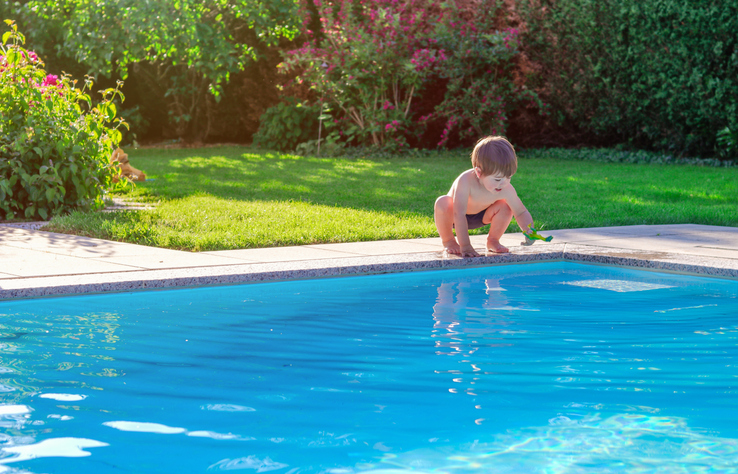
 This article has been sitting in my head for a while.
Every summer, I see the headlines. Every summer, I think about writing something. And every summer, I struggle with how to talk about drowning without sounding preachy, judgmental, or like I’m repeating the same water safety advice Arizona parents have already heard a hundred times.
But after the recent child drowning in Gilbert, I finally sat down to put my thoughts into words because I found myself asking, once again, the same question so many parents ask when they see these headlines:
How does this keep happening?
Over the past few weeks, I’ve watched reports of child drownings and near drownings trickle in from across the Valley. Every summer, they begin appearing with increasing frequency, and every summer they stop me in my tracks.
As a parent of five who spends a lot of our summer poolside, they’re the stories I dread reading. As the publisher of Raising Arizona Kids, it’s a topic I wish we didn’t have to cover year after year.
What’s particularly frustrating is that Arizona families know better.
We talk about water safety constantly. Schools talk about it. Swim schools talk about it. Pediatricians talk about it. News stations remind us every summer. Most parents can probably recite the basics from memory: swim lessons, pool fences, CPR, active supervision.
And yet, children still drown.
To be fair, there was encouraging news last year. Arizona saw a significant decline in fatal drownings among children ages 5 and younger in Maricopa and Pinal counties, dropping from 19 deaths in 2024 to eight in 2025. That’s real progress, and it’s worth celebrating.
But even during the cooler months, drowning incidents continued to occur, reminding safety advocates that water dangers don’t disappear when summer ends. And now, as temperatures rise and families return to pools, splash pads, lakes, and backyard barbecues, many parents are once again seeing heartbreaking headlines appear in their news feeds.
The question isn’t whether Arizona parents know about water safety. The question is why knowledge alone doesn’t seem to be enough.
It’s easy to assume drowning happens because someone wasn’t paying attention. Because a parent was careless or irresponsible. Are there drowning incidents caused by outright negligence? Absolutely. But if you pay attention to many of the stories behind these tragedies, you’ll often find families who loved their children deeply and never imagined something like this could happen to them.
Often, the cause isn’t a parent who didn’t care. It’s a brief lapse in attention. An assumption that another adult was watching. A gate left unlatched. An older child who forgot to close it behind them. A toddler who moved faster than anyone expected. A series of small mistakes that, on any other day, wouldn’t have mattered.
That’s what makes these stories so difficult to read as a parent. They remind us that while some tragedies are preventable through better choices, others happen in situations that feel uncomfortably familiar to many families.
The uncomfortable truth is that parents are human.
A toddler slips out a back door while a parent changes a diaper. Mom thinks Dad is watching. Dad thinks Grandma is watching. Someone answers a phone call. Someone runs inside to grab towels. A pool party has a dozen adults nearby, yet no one is specifically assigned to watch the water.
None of those situations sound outrageous because they’re not. They’re everyday moments in family life.
That’s why I believe the conversation around drowning prevention needs to move beyond awareness. Most Arizona families are already aware. What saves lives are the layers of protection that account for the fact that even the most attentive parents get distracted sometimes.
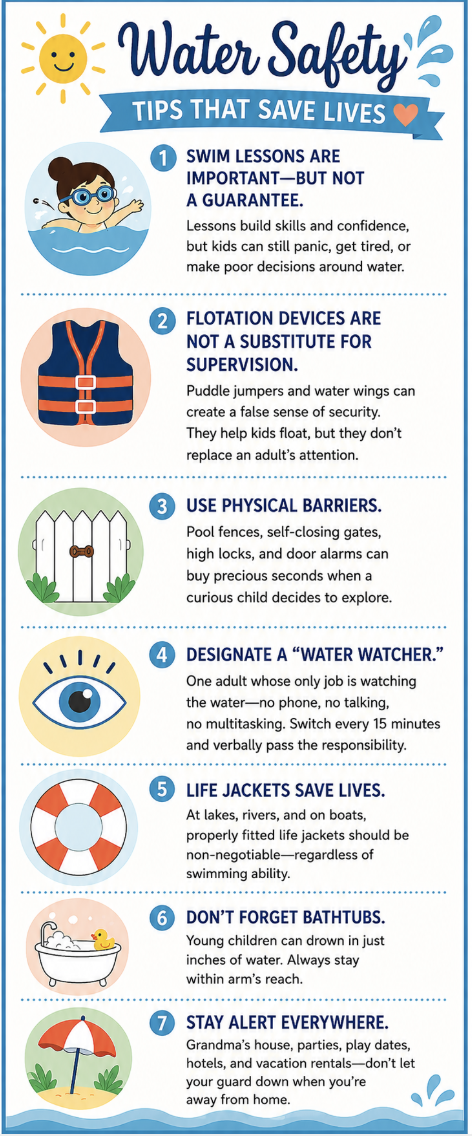
Swim lessons are one of those layers, but they’re not a guarantee. A child who has taken lessons can still panic, become exhausted, or make a poor decision around water.
The same goes for flotation devices. Many parents don’t realize that puddle jumpers and water wings can create a false sense of security for both children and adults. They may help a child float, but they don’t replace supervision. They can also encourage children to feel more confident around water than their actual swimming abilities allow. A child who is used to feeling supported every time they’re in the pool may be more likely to approach the water independently, forgetting that the flotation device isn’t always there.
And for the record, I’m not knocking life jackets or flotation devices altogether. They’re valuable tools and can be incredibly helpful, especially for younger children. They make it easier to hold little ones in the water, allow families to spend more time swimming together, and can help build confidence. The problem isn’t the device itself—it’s when we start treating it as a substitute for active supervision rather than one additional layer of protection.
When we’re talking about pools, physical barriers are the first line of defense. Pool fences, self-closing gates, high locks on doors, and door alarms or chimes that alert you when someone heads outside can buy precious seconds when a curious toddler decides to explore. For families spending time at lakes or on boats, properly fitted life jackets should be non-negotiable, regardless of a child’s swimming ability. Brightly colored swimsuits can also make children easier to spot underwater than blues, grays, or other colors that blend into the water.
One of the most practical pieces of advice I’ve heard is to designate a “Water Watcher” anytime children are swimming. Not someone casually keeping an eye on the pool while chatting with friends, grilling burgers, or scrolling through their phone. One adult whose only job is watching the water. No bathroom breaks. No drink refills. No conversations. Just watching the pool.
And because that’s harder than it sounds, switch Water Watchers every 15 minutes. When one adult is done, they should verbally hand the responsibility to the next person. Not assume. Not point. Actually say, “You’re watching the pool now,” and get confirmation back.
For larger gatherings, it may even be worth hiring a lifeguard. It might sound excessive for a birthday party or backyard barbecue, but so does every safety precaution—until the day you need it.
While much of the drowning conversation focuses on pools, it’s worth mentioning bathtubs too. Every year, young children drown in tubs after being left alone for what was intended to be just a moment. The same rule applies: if a young child is in the water, an adult should be within arm’s reach.
It’s also easy to pass judgment when we read these stories. Most of us have had the thought: I would never let that happen.
But the longer I’ve been a parent, the more I’ve realized we’re all capable of mistakes. That’s not an excuse—it’s reality.
It’s easy to feel confident about the safety measures in your own home. But what about Grandma’s house if she has a pool? Does she have the same level of security that you do? What about birthday parties, family gatherings, play dates, hotels, beach or lake days, or vacation rentals? It’s surprisingly easy to let your guard down when you’re outside your normal routine or when there are multiple adults around and you assume someone else is paying attention.
In our own family, it’s one of the reasons we chose not to have a pool at home. That’s not a judgment on families who do—I know many who manage it safely and responsibly. But I work from home, which means I’m distracted all day long. I’m answering emails, taking calls, writing articles, coordinating schedules, and juggling the countless interruptions that come with raising five kids.
I also have older boys who are responsible and helpful, but they’re still kids. They’re old enough to open a gate and young enough to prop it open without thinking. Old enough to let the dog out and forget to latch a door behind them. That’s not a criticism of them. It’s simply an acknowledgment that children make mistakes and adults get distracted.
Maybe that’s the hardest part of these stories. They force us to acknowledge that drowning doesn’t always happen because someone lacked knowledge. Sometimes it happens despite loving parents, despite good intentions, and despite years of hearing the same safety messages.
Because drowning isn’t usually the result of parents who didn’t care. More often, it’s the result of a moment that almost every parent can imagine happening in their own home.
That’s exactly why awareness can’t be our only strategy. The goal isn’t perfect parenting. The goal is creating enough layers of protection that when real life happens—as it inevitably does—our children are still safe.