

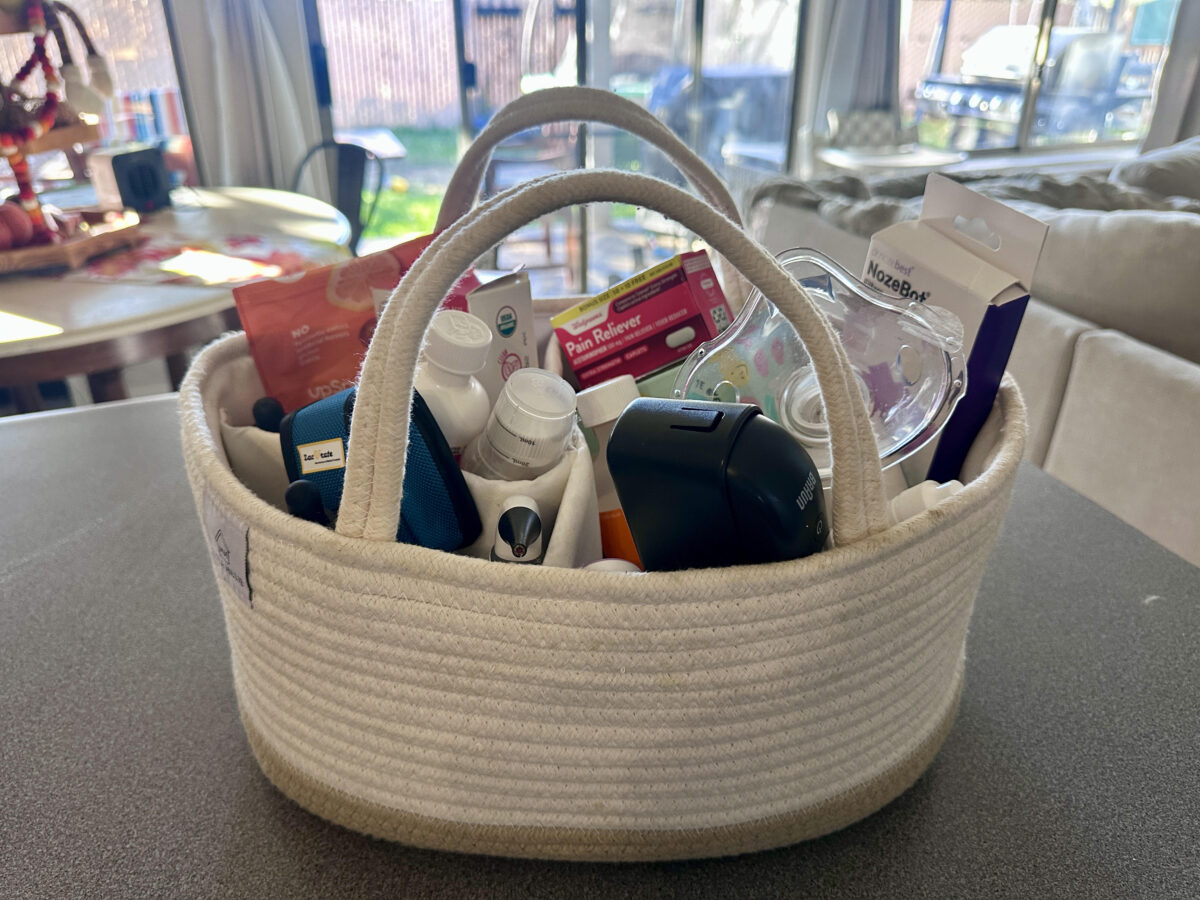
 From middle-of-the-night fevers to stomach bugs and stuffy noses, here’s what we keep on hand for babies, toddlers, kids, teens, and parents.
With five kids ranging from toddler to teenager, we’ve accumulated quite the collection of medicines, gadgets, and sick-day supplies over the years.
Recently, I realized our youngest was outgrowing some of her infant medications and moving into the next stage of children’s medicines. That meant it was time to pull out our medicine basket, check expiration dates, see what we were running low on, and figure out what we actually needed to keep.
And with another baby on the way, you might think I’d just save everything. But the reality is that many of those infant medications will expire before she’s old enough to need them.
When everyone is healthy, we usually manage to get everything organized back into one place. But when a bug starts making its way through our house? It looks like a pharmacy has moved in.
After years of middle-of-the-night fevers, stomach bugs, ear infections, and coughs that seem to get worse the second everyone goes to bed, I’ve learned which things are worth having on hand before you need them.
Some are basic, inexpensive medicines. Others are gadgets I never imagined we’d own before having kids. And a few aren’t medical supplies at all, just little tricks we’ve picked up that make sick days a whole lot easier.
Here’s what we keep in our family’s sick-day cabinet, what we’ve found helpful, and a few things I wish I’d known to stock up on sooner.
Note: I’m a mom, not a medical professional. These are the supplies and routines that work for our family, not a recommendation to use every product for every child. Always follow age and weight restrictions, check active ingredients, and consult your pediatrician about medications and treatments.
Fever and Pain Relief Essentials
Children’s Acetaminophen and Ibuprofen
If there’s one thing I never want to run out of in the middle of the night, it’s children’s pain and fever medicine.
We keep both acetaminophen (Tylenol) and ibuprofen (Motrin or Advil) on hand, along with age-appropriate versions for our younger and older kids.
I’ve bought everything from name brands to store brands like up&up and GoodSense, as well as Genexa. As long as the active ingredient and concentration are the same, generic versions can work just as well.
With kids ranging from toddler to teenager, we also keep different forms available, including liquids and chewables. My oldest can just swallow pills.
Mom Tip: I don’t automatically treat every fever.
Fevers serve a purpose. If one of my older kids has a fever but is comfortable, drinking, and otherwise acting reasonably well, I don’t necessarily rush to give medicine just to bring the number down.
But if they’re miserable, uncomfortable, or having trouble resting? Absolutely. That’s when I’ll reach for something to help them feel better.
For babies under 3 months, a temperature of 100.4°F (38°C) or higher needs immediate medical evaluation. Ibuprofen generally shouldn’t be given to babies under 6 months.
Medicine Syringes and Dosing Tools
You can never have too many medicine syringes. Between the ones that disappear, get lost in the dishwasher, or come with a bottle but don’t work particularly well, I’ve learned to keep extras on hand. I find the numbers also start to wash off after a while.
I really like the extra-long medicine syringes from Ryan & Rose. They’re especially helpful when you’re trying to give medicine to a little one who doesn’t want to take it.
We also have a dial-style medicine dispenser that lets you select the dose before dispensing. It’s one of those little conveniences you don’t realize you appreciate until you’re measuring medicine in the middle of the night.
Whatever you use, make sure it’s designed for medication dosing and has clear milliliter markings.
Mom Tip: Write Down Every Dose of Medicine
If there’s one thing I’ve learned after five kids, it’s that you should never trust your memory when you’re exhausted and dealing with sick children.
Did I give Motrin or Tylenol last? Was it around 9 p.m. or closer to 10? How much did I give? And is it too soon for another dose?
Rather than trying to do the math in the middle of the night, I write down each child’s current weight, the medication, the exact dose, and the time it was given.
You can write it on a sticky note attached to the medicine cabinet, keep a dry-erase board on the fridge, or tape a simple log next to the medication.
For example:
Sonja | 20 lbs | Children’s Tylenol | 3.75ml (or the dose your pediatrician has recommended) | 5:37 p.m.
That way, when my husband takes over, he knows exactly what was given and when. No guessing, no accidentally giving another dose too soon, and no trying to remember which child got which medication.
I also keep the correct, pediatrician-confirmed dose for each child handy so we’re not trying to calculate it while half asleep. Just remember to update it as they grow and always check the medication’s concentration.
Mom Tip: Acetaminophen (Tylenol) and ibuprofen (Motrin) can sometimes be alternated when a stubborn fever returns before the next dose is due. Check with your pediatrician first, and always write down which medicine you gave, how much, and when to avoid accidentally giving another dose too soon.
Cooling Pads and Compresses
Sometimes a child with a fever just wants something cool on their forehead.
We keep soft washcloths, reusable cool packs, and cooling pads like those from Frida on hand. They’re primarily for comfort rather than actually lowering core body temperature, but when a child feels miserable, little things can make a difference.
Avoid ice baths, rubbing alcohol, or anything that makes your child shiver.
Thermometers: Why We Own More Than One
You might wonder why we have multiple thermometers. After years of taking temperatures on everyone from newborns to teenagers, I’ve learned that each one has its place.
Rectal thermometer: We have the Frida Baby digital rectal thermometer. For babies, especially newborns, accuracy matters. If I really need to know an infant’s temperature, this is what I reach for because rectal readings are generally the most accurate for young babies.
Ear thermometer: We love our Braun ear thermometer so much that we actually have two in the house! It’s quick, convenient, and our everyday option for the older kids. Ear thermometers can be accurate when used correctly, but positioning matters, and they’re not recommended for babies under 6 months.
Forehead thermometer: We have the NozeBot forehead thermometer, which uses technology designed to improve measurement accuracy. I especially appreciate being able to check a sleeping child during the night or at nap time without disturbing them. No-touch readings can still vary, so if I need a more precise temperature, I’ll verify it with another thermometer when appropriate.
Mom Tip: I don’t automatically wake a comfortably sleeping child just to take their temperature or give fever medicine. If they’re breathing comfortably, have normal color, and aren’t showing concerning symptoms, I generally let them rest and check on them periodically.
Of course, very young infants and children with concerning symptoms are different. A baby under 3 months with a temperature of 100.4°F or higher needs immediate medical evaluation, and I wouldn’t rely on a forehead thermometer alone to rule out a fever in a young infant.
Stuffy Noses, Congestion, and Breathing Comfort
Nasal Aspirator and Saline Spray
If you have a baby or toddler who can’t blow their nose yet, a nasal aspirator is a must-have. We have the NozeBot, which I highly recommend!
The key is pairing your aspirator with saline drops or spray. Saline helps loosen mucus so it’s easier to remove.
We keep saline products like Little Remedies on hand, but there are plenty of affordable alternatives.
I also like keeping gentle saline nose wipes available. Brands like Boogie and The Honest Company offer options designed for sensitive noses, but I usually buy whichever is on sale.
After a few days of constant nose wiping, even the softest tissues can start irritating little noses.
Nebulizer and Sterile Saline
A nebulizer is another item we’ve found helpful to have at home when one of the kids is stuffed up. We’ve never needed a medical nebulizer treatment so I can’t speak to that.
We have a portable nebulizer, which is convenient because it’s easy to use without setting up a large machine. You just charge it, fill with saline, and it helps to soothe airways and loosen mucus.
For saline treatments, use only sterile saline specifically intended for nebulization, in the concentration and amount recommended by your child’s clinician.
I find having the portable nebulizer is cheaper than the one time use canisters you can buy in the store for little ones. They add up!
Cool-Mist Humidifier
A humidifier is another one of those things I think every family with young kids should have on hand. Between stuffy noses, nighttime coughing, and dry winter air, ours gets plenty of use during sick season.
I prefer a cool-mist humidifier, especially with little ones, because there’s no risk of burns from hot water or steam. You don’t need anything fancy. Just look for something that’s easy to fill and, more importantly, easy to clean.
Use distilled water when possible, empty and dry the tank daily, and follow the manufacturer’s cleaning instructions. A dirty humidifier can actually make respiratory symptoms worse. We have hard water so we use distilled water to prevent build up.
Chest Rubs and Soothing Balms
Chest rubs are another staple in our house during cold and flu season. There are so many options available for kids, including Vicks, Boogie, Zarbee’s, Motherlove, Badger, and Earthley.
You’ll find everything from traditional vapor rubs to gentler balms marketed for babies and young children. Some come in jars, while others have convenient stick applicators.
Personally, I love the stick versions because they’re quick, easy, and less messy, especially when I’m trying to get a congested child comfortable before bed. That said, I haven’t found the sticks to be quite as effective for us as some of the traditional balms.
My advice? Choose a product you’re comfortable with, that fits your budget, and that is appropriate for your child’s age.
These products are primarily for comfort. Some create a sensation of easier breathing without actually clearing congestion. Always check age recommendations and ingredients, particularly menthol, camphor, and essential oils. Never apply them inside or directly beneath a child’s nose. Sometimes we even add them to feet under socks.
Nasal Strips
Nasal strips are another option for older kids who are dealing with stuffiness at bedtime.
Dimetapp makes children’s nasal strips, and other brands offer similar products. They may help some children feel less congested, although they don’t treat the underlying illness.
Check the age recommendations and avoid applying them to irritated or broken skin.
Saline Nasal Rinse for Older Kids and Adults
This one is more for me than the little kids! I’ve dealt with sinus infections, and I like having a clean, unopened nasal rinse kit ready when congestion gets particularly bad.
There are several options available, including squeeze-bottle rinse kits and premeasured saline packets.
Important: Always use distilled, sterile, or previously boiled and cooled water. Never use untreated tap water for nasal rinsing.
Coughs, Sore Throats, and Cold Medicine
Age-Appropriate Cough and Cold Products
Our medicine cabinet has included products from KinderMed, Genexa, Hyland’s, Earthley, and other brands over the years. But I don’t believe every family needs every cough medicine on the shelf.
I pay attention to the child’s age, symptoms, and what the product is actually intended to do.
Mom Tip: I don’t automatically try to suppress every cough.
Coughing is one way the body clears mucus and irritants from the airways. Sometimes the best approach is fluids, rest, and comfort measures rather than trying to stop every cough.
That said, I understand wanting to help a miserable child get some sleep. For older children, an appropriate medication may sometimes be an option after checking with their pediatrician.
Over-the-counter cough and cold medicines are not recommended for children under 4, and many products have higher age minimums. Always follow the specific label and your pediatrician’s advice.
Be especially careful with multi-symptom products. Some contain acetaminophen or other ingredients already present in medicines you’re giving separately. This is why I recommend writing down dosages and times!
Honey and Warm Tea
For children over a year old, honey can be a simple way to soothe a cough or sore throat.
My 8- and 13-year-olds will happily drink warm tea with honey, which is another great way to encourage fluids when they’re sick.
I like having caffeine-free tea available, along with honey, lemon, and other simple additions.
Just make sure drinks aren’t too hot, and never give honey to babies under 12 months.
Cough Drops, Throat Lozenges, and Sprays
With a teenager in the house, we’ve reached the stage where cough drops and throat lozenges are useful.
My oldest uses them, and so do we as adults. For younger kids, though, they can be a choking hazard, so I stick to age-appropriate alternatives.
We also keep sore throat spray available for those old enough to use it safely. For teens and adults, a warm saltwater gargle is another simple option. Mix about half a teaspoon of salt into a glass of warm water, gargle, and spit it out. Just FYI…it’s not pleasant. But it does help.
Earaches and Ear Infections
An Otoscope for Virtual Visits
An otoscope is one of those gadgets I never expected to own before having kids.
But when you have multiple children and deal with your share of ear infections, it can be helpful, particularly if you’re using a virtual pediatric service that can review images or video from a compatible device.
Of course, owning an otoscope doesn’t mean I can diagnose an ear infection myself. That’s still the pediatrician’s job. But I can easily tell if it’s irritated…and when the kids have a lot of wax!
Earache Drops and Comfort Measures
We’ve used Rowe Casa Earache Oil for comfort, and it’s one of the products I’ve personally found helpful to have available.
A comfortably warm compress held against the outside of the ear can also help with discomfort.
However, ear drops and oils aren’t appropriate for every situation. Don’t put oil into an ear if there’s drainage, ear tubes, or a possible ruptured eardrum unless a clinician specifically approves it. These products don’t replace treatment for an ear infection.
Mom Tip: Don’t Wait Until Ear Pain Is Unmanageable
As a mom who’s dealt with more than my fair share of ear infections, I’ve learned to keep an eye on symptoms and loop in our pediatrician before things become unmanageable.
Not every ear infection requires antibiotics, and many improve on their own. We’ve had occasions when our pediatrician has said something along the lines of, “I’ll go ahead and send in the prescription so it’s ready. Give it a little time and see if things improve first.”
I love this approach because we’re not rushing to give antibiotics unnecessarily, but we’re also not scrambling to get an appointment or prescription if symptoms worsen over the weekend.
Depending on the child’s age, symptoms, and examination, a pediatrician may recommend watching and waiting for 48–72 hours.
Of course, this isn’t appropriate for every ear infection. Severe pain, ear drainage, swelling behind the ear, or high fever should be evaluated promptly. Babies under 6 months with suspected ear infections should be assessed rather than managed with watchful waiting at home.
Stomach Bugs, Vomiting, and Hydration
Electrolytes and Oral Rehydration Products
When a stomach bug hits, hydration becomes one of my biggest priorities. We keep electrolyte packets like Liquid I.V. available, along with other drinks the kids are willing to have.
But it’s important to distinguish everyday electrolyte drink mixes from oral rehydration solutions specifically formulated for fluid loss from vomiting and diarrhea.
For a child who’s losing fluids, products such as Pedialyte or equivalent pediatric oral rehydration solutions are generally the better choice.
I especially like the idea of keeping shelf-stable packets or oral rehydration freezer pops on hand. They don’t take up much room, and you don’t have to worry about running out in the middle of the night.
Popsicles, Lemonade, Ginger Ale, and Whatever They’ll Drink
Sometimes half the battle is just getting a sick child to drink something. We keep popsicles, lemonade, lemon-lime soda, ginger ale, and other favorites available because when kids don’t feel good, they can become surprisingly picky.
For mild illnesses, offering fluids they’ll willingly drink can be helpful.
For vomiting, diarrhea, or dehydration, though, oral rehydration solution is preferable to soda or juice, which can sometimes make diarrhea worse. Small, frequent sips are often easier to tolerate than drinking a large amount at once.
Stomach-Soothing Products
We also keep a few stomach-relief products available for older children and adults, including UpSpring Stomach Settle drops, Emetrol Children’s Nausea Relief, and Children’s Pepto products.
Just be careful: Regular Pepto-Bismol contains bismuth subsalicylate, an aspirin-related ingredient, and shouldn’t be given to children under 12 or to children and teenagers recovering from viral illnesses because of the risk of Reye syndrome.
Vomit Bags and Cleanup Supplies
Disposable vomit bags are one of those things you might not think to buy until you desperately need them. They’re inexpensive, take up very little space, and are great for keeping beside the bed or in the car. Grocery bags also work in a pinch but I find little kids don’t have the capability to make it anywhere other than the bed or floor.
I also recommend having lots of disinfectant available.
Mom Tip: Layer the Bed Before the Next Vomiting Episode
One thing we’ve learned after five kids is to keep plenty of old beach towels, waterproof mattress protectors, and extra blankets on hand when a stomach bug hits. Rather than constantly changing the entire bed, we layer old mattress protectors and beach towels underneath the sick child, with extra clean layers ready to go.
My kids tend to get really upset when they throw up, so the last thing I want is for them to worry about making a mess. Our response is usually a quick, “It’s okay! No worries!”
One parent helps the child get cleaned up or takes them for a bath if needed, while the other strips off the dirty layers, tosses everything in the wash, and gets the bed ready again. Within a few minutes, everyone is clean, comfortable, and hopefully back to sleep.
My advice: Don’t throw away those old beach towels or mattress protectors just yet. They might become your most valuable supplies during the next stomach bug!
Tools That Make Virtual Pediatric Visits Easier
Pediatric and Adult Pulse Oximeters
One thing I’ve learned from using Blueberry Pediatrics is that sometimes the doctor needs a little more information than I can provide just by describing symptoms. That’s why we keep both pediatric and adult pulse oximeters at home.
I purchased ours on Amazon, and they’re especially helpful when we’re doing a virtual appointment and the pediatrician asks for an oxygen saturation or heart rate reading. It’s not something I use every time one of the kids gets sick, but it’s nice to have available when the doctor requests it.
Make sure the device is designed for the age and finger size of the person using it. Adult models aren’t always reliable on little fingers. And remember, a pulse oximeter doesn’t replace watching for breathing difficulties. If your child is struggling to breathe, seek emergency care rather than relying on a reading.
Related: The Kids Are Sick Again! Our Experience With Blueberry Pediatrics
Keep Important Information Ready
When contacting a pediatrician, it helps to have a few things ready:
- Your child’s current weight and temperature.
- When symptoms began.
- Medications given, including exact doses and times.
- How much your child has been drinking and urinating.
- Photos of a changing rash or a short video of intermittent symptoms, if safely obtained.
- Pulse oximeter readings or otoscope images if your pediatrician requests them.
Having that information available can make an appointment much easier, especially when you’re trying to explain symptoms in the middle of the night.
Other Supplies Worth Keeping on Hand
Not every sick-day essential comes in a medicine bottle.
Allergy medicine: We keep an age-appropriate allergy medicine such as Benadryl available when recommended for our children. Antihistamines have different age restrictions and uses, and Benadryl shouldn’t be used simply to make a child sleepy. Severe allergic reactions require emergency care and epinephrine when prescribed.
Lip balm and petroleum jelly: Helpful for chapped lips and irritated skin after days of mouth breathing or wiping noses.
Diaper rash cream: Especially useful when a stomach bug causes frequent diaper changes.
Extra medicine syringes: Keep more than you think you’ll need.
A backup thermometer and batteries: Because devices have a way of dying at the worst possible moment.
Spare nebulizer and nasal aspirator parts: If you use these devices, check whether you need replacement masks, filters, or tubing.
Easy foods: Broth, soup, crackers, applesauce, and other foods that are easy to prepare when everyone feels miserable.
Quiet activities: Sticker books, coloring supplies, audiobooks, and a favorite movie can make a long sick day more manageable.
Prescribed rescue medications: Families with children who have asthma or severe allergies should keep prescribed rescue inhalers, spacers, or epinephrine auto-injectors accessible and check expiration dates. Follow your child’s emergency action plan.
Poison Control information: Save 1-800-222-1222 in your phone before you ever need it.
When to Call the Pediatrician: Warning Signs Parents Should Know
After five kids, I’ve learned that not every fever, cough, or runny nose requires a trip to the pediatrician. Sometimes kids just need rest, fluids, and a little extra attention.
But knowing when not to wait is just as important as knowing how to care for a sick child at home. Just as a reminder, I’m just a mom–definitely consult your pediatrician if you have any concerns.
Breathing Warning Signs You Should Never Ignore
When my kids have a respiratory illness, I pay attention to how they’re breathing, not just how much they’re coughing.
Seek emergency medical care if your child:
- Is struggling to breathe, gasping, or unable to speak or cry normally because of difficulty breathing.
- Has blue, gray, or unusually pale lips or a blue or gray tongue.
- Has skin pulling in between the ribs, under the ribs, or around the neck with each breath. These are called retractions.
- Is making grunting noises with each breath or has severe, persistent noisy breathing.
- Has pauses in breathing, is difficult to wake, or seems unusually limp or unresponsive.
Call your pediatrician promptly if you notice:
- Breathing that’s consistently faster than normal while your child is resting.
- Wheezing or new noisy breathing.
- A cough that’s getting worse instead of better.
- A baby who’s struggling to feed because of congestion or breathing difficulties.
A pulse oximeter can provide useful information when your pediatrician requests it, but a normal reading doesn’t necessarily mean everything is fine.
Other Signs Your Child May Need Medical Attention
Fever: Any temperature of 100.4°F (38°C) or higher in a baby younger than 3 months requires immediate medical evaluation. For older children, call about fever lasting more than three days, fever that returns after improving, or a child who seems unusually ill. Fever with a stiff neck, confusion, severe headache, or concerning rash needs urgent assessment.
Dehydration: Watch for significantly fewer wet diapers or bathroom trips, very dry mouth, no tears when crying, sunken eyes, or unusual sleepiness.
Ear pain: Persistent or severe pain, ear drainage, swelling behind the ear, or pain accompanied by high fever should be evaluated.
Vomiting and diarrhea: Contact your pediatrician if vomiting is persistent, your child can’t keep fluids down, or there’s blood in the stool. Green vomit, severe abdominal pain, or significant dehydration need urgent evaluation.
Changes in behavior: A child who’s unusually difficult to wake, confused, inconsolable, or not responding normally needs medical attention.
And if something simply seems significantly different from your child’s usual behavior, it’s okay to call. Most pediatricians have after hour lines. Your insurance might have a nurse line as well!
When to Clean Out and Restock Your Family Medicine Cabinet
This whole article started because our toddler was outgrowing some of her infant medications, and I realized it was time to go through everything.
I recommend taking inventory whenever a child moves into a new age or weight range, before cold and flu season, and after a particularly rough stretch of illnesses.
Check expiration dates, throw out products that are no longer usable, update medication dosing information, and make a list of anything you’re running low on.
Remember that different infant and children’s products may have the same or different concentrations. Don’t assume a new bottle requires the same number of milliliters as the old one.
Store medicines securely out of children’s reach, even during sick weeks when it feels like your supplies are everywhere. Dispose of expired or unused medications.
Family Sick-Day Essentials Checklist
Here’s a quick list of items worth considering for your own family, depending on your children’s ages and medical needs.
Fever and pain
- Acetaminophen and ibuprofen in age-appropriate formulations
- Accurate digital thermometer
- Ear or forehead thermometer
- Medicine syringes and dosing tools
- Medication log
- Cool compresses or cooling pads
Congestion and cough
- Saline nasal drops or spray
- Nasal aspirator
- Soft saline nose wipes
- Cool-mist humidifier
- Age-appropriate chest rub
- Honey for children over 1 year
- Caffeine-free tea
- Age-appropriate throat-soothing products
- Nebulizer and prescribed supplies, if recommended
- Nasal rinse kit for appropriate older users
Stomach bugs
- Pediatric oral rehydration solution or packets
- Oral rehydration freezer pops
- Favorite drinks and easy foods
- Disposable vomit bags
- Old beach towels
- Waterproof mattress protectors
- Extra pajamas and blankets for older children
- Diaper rash cream
- Cleaning and disinfecting supplies
Doctor visits and other essentials
- Otoscope, if used with your pediatrician
- Appropriately sized pulse oximeter, if requested
- Allergy medicine appropriate for your child
- Prescribed rescue medications, if applicable
- Pediatrician and after-hours contact information
- Poison Control number
- Replacement equipment parts and batteries
A Little Preparation Goes a Long Way
I don’t think every family needs a medicine cabinet that looks like ours. And you certainly don’t need to buy every name-brand product on the market.
But after years of caring for sick kids, I’ve learned that having a few essentials available before you need them can make a difficult night much easier.
Sometimes it’s a thermometer that doesn’t require waking a sleeping child. Sometimes it’s having the right medicine and knowing exactly when the last dose was given. And sometimes it’s nothing more than a stack of old beach towels ready for the next stomach bug.
Because when your child wakes up miserable at 2 a.m., the last thing you want to be doing is figuring out what’s open, what you can have delivered, or where you put the medicine syringe.
A little preparation while everyone is healthy can make those sick days a whole lot less stressful.